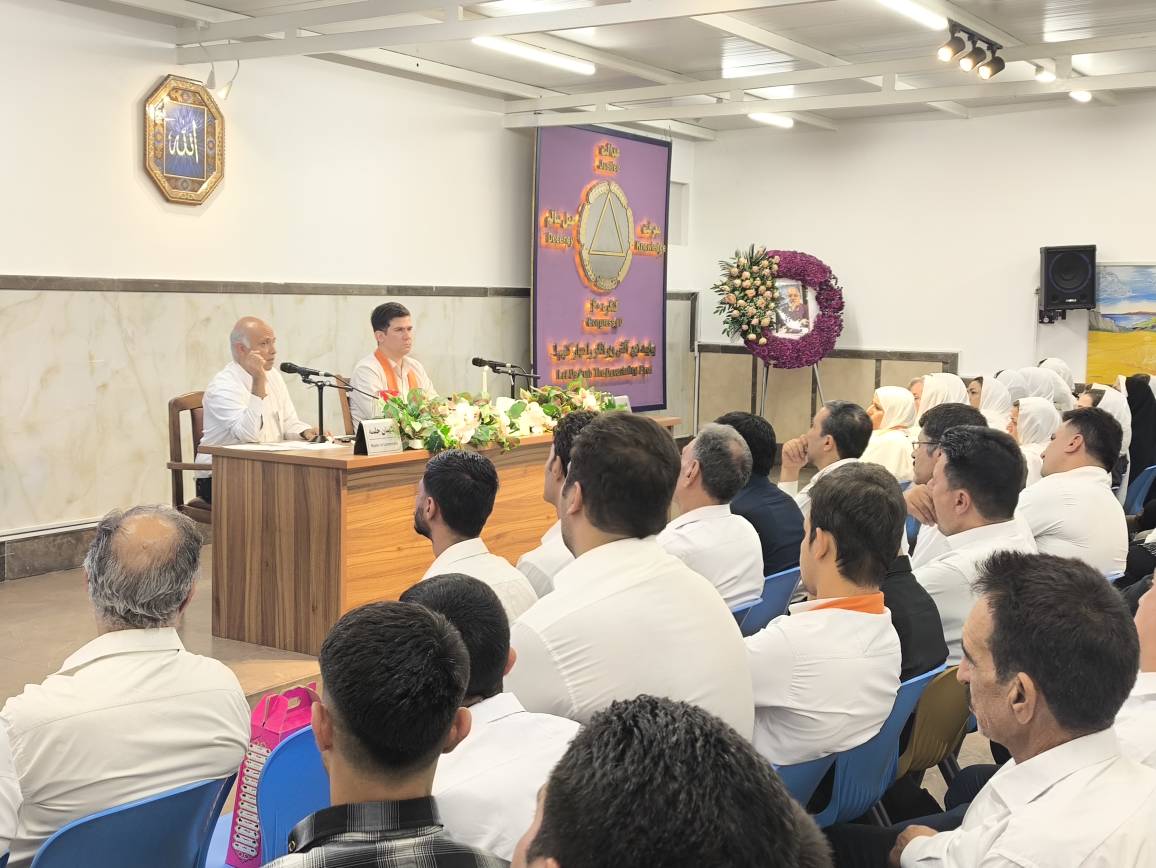
The fourth session of the 88th series of Congress 60’s educational workshops for travelers and companions was held on Wednesday, October 21, 2026, under the topic “Honoring Mr. Hossein Dezhakam and His Scientific Achievements (Books).” The session was chaired by Dr. Amin Dezhakam as the guest speaker and the Guardian, with Traveler Mohammad Hossein serving as secretary.
Dr. Amin Dezhakam: Relying on the power of the Almighty God, we begin this session. Hello, my friends. I am Amin, a traveler. I would like to ask you to observe fourteen seconds of silence for our own liberation from ignorance and lack of awareness, and to seek refuge in Almighty God. Thank you very much. I would now like to ask our secretary to read a summary of the previous session.
Session Secretary: This is the fourth session of the 88th series of Congress 60’s educational workshops on the science of worldview, held for travelers and companions. The session was chaired by Dr. Amin, the respected deputy of the Base of Congress 60, and I, Traveler Mohammad Hossein, served as secretary. The topic was “Honoring Mr. Hossein Dezhakam and His Scientific Achievements (Books).” The session commenced at precisely 10:39 a.m. on Wednesday, October 21, 2026.
With respect,
The Session Secretary
Dr. Amin Dezhakam: Hello, my friends. I am Amin, a traveler. Well, we are, in fact, in a period of mourning [following the sudden passing of Mr. Hossein Dezhakam], and I would like to talk to you a little about what has been done and what we still need to do.
First, I would like to express my deepest gratitude to my family and the Council of Didebans (Watchers), who have worked incredibly hard despite the extremely difficult emotional circumstances we have been facing. From the very night this happened, we began working to safeguard Congress 60. After all, Congress 60 is Mr. Dezhakam’s greatest achievement. All his scientific work and discoveries are contained within a vessel or container and that vessel is Congress 60. We therefore had to do everything possible to protect and preserve it.
When this happened at around six or seven o’clock [p.m.], we still hoped he might recover within the next three or four days. According to the information we had, two out of every thousand people could return to life. Moreover, what happened to Master Dezhakam was entirely unexpected. He had been in perfect health that very morning. His physician had discharged him from the hospital. He underwent surgery on Monday and was discharged on Tuesday, but Master Dezhakam said he would prefer to remain in the hospital.
Everything was orderly, and everything appeared normal. We were with Mr. Dezhakam, talking and joking with him [Wednesday, October 7, 2026]. Just an hour before the incident, both Mrs. Kamandar [Mr. Dezhakam’s elder daughter] and I had been with him. When we returned home, we were making preparations for his arrival when the incident occurred.
Therefore, under no circumstances could we believe that he could be gone, because he had been in perfectly good health. We waited, taking into account his research findings and own perspective, and assessed his condition every day. After three or four days, consultations with specialists helped us understand that physical signs such as the cessation of breathing and the heartbeat are not, in themselves, definitive indications of death [in the book Crossing the Zone of 60 Degrees below Zero, Master Dezhakam mentioned that cessation of breathing and the heartbeat are not the signs of death, maybe the Silver Band connecting body to Self has still remained active, according to Master Hossein Dezhakam, death means the separation of the Second Body from the human being]. That is why we waited.
The only definitive sign of death, based on our own experience, is the decomposition of the body. For example, my mother, Mrs. Annie’s father, regained consciousness and revived in a morgue. Another case involved Mr. Dezhakam’s first pupil in Congress 60, whose addiction was cured using the DST method and who wrote the poem “The Song of Congress 60.” He, too, regained consciousness and revived in a morgue. So we had these experiences, and we knew that such an occurrence was neither extraordinary nor illogical.
The only sign that definitively confirms death is the decomposition of the body, which begins gradually in certain specific areas and has recognizable signs. Even by the second or third day, none of these signs had appeared. The face usually changes, but his face had not changed at all, even by the day of his burial. This surprised everyone. However, changes had occurred in his pupils [of the eyes] and certain other areas, and we eventually concluded that, yes, he had passed away. This conclusion was reached approximately three or four days after the incident.
Now, some people talk about this and make superstitious claims, saying, for example, that it takes three days for the soul to leave the body. No, that is not true. Such statements are based on misconceptions and unscientific interpretations. We do not believe that the soul takes three days to emerge from the body, as though it were gradually being released. That is simply not our understanding.
What we are saying is that, according to scientific research, out of every thousand people, two may return to life. There is documented evidence for this, and the phenomenon has been firmly established. If we waited, it was entirely in accordance with Mr. Dezhakam’s perspective. He was an outstanding scientist, and we followed his approach and waited.
There are some people who look for opportunities to draw certain conclusions or make insinuations about such events. I spoke with government officials, and they cooperated with us extensively and provided considerable assistance. In fact, the location selected for Master Dezhakam’s final resting place was chosen by the authorities. The government officials offered us two options, and we selected one: the Imamzadeh Ali Akbar shrine, which was a very suitable location.
I remember that before discovering the DST method, Master. Dezhakam had been in Kerman, where he would visit the shrine of Shah Nematollah Vali, he would pray and worship there. When I later traveled to Kerman, I also visited Shah Nematollah Vali. After returning and seeing the place where Master Dezhakam was laid to rest, I was struck by how much it resembled the place he had loved. There was a remarkable similarity between the two places.
The funeral was intended to be a private ceremony, and that was the right approach. It was meant for the family and close friends. Otherwise, the immediate family would not have been able to carry out the funeral rites or grieve in peace. If five hundred or a thousand people had gathered there, the ceremony would have become unmanageable. People would have pushed forward, forcing the family back, and the family would no longer have been able to say goodbye to their loved one’s body in peace.
A burial ceremony is an occasion to pay respect to the physical body. I explained this because the person’s spirit had lived in that body. We believe in the afterlife and in resurrection, and we believe that the angels of death come to take the Self from the body. The body remains behind, while the person [’s Self] passes into the afterlife. The person’s entire being is taken away [by the angels], completely and in its entirety. What remains is the physical body, a kind of garment the person once wore, yet it is still worthy of respect.
When you love someone, you also show respect for their car and their home. In the same way, when you love someone, you respect the physical body in which that person lived. A funeral, therefore, is an expression of respect for the body of our loved one.
But genuine respect goes beyond that. Many people told me they wanted to attend the burial ceremony. I explained that while we might wish to be there, the first right belongs to the family and close friends. Afterward, however, others could also come and pay their respects. We made the necessary arrangements to allow this to happen, and it did [Congress 60 members visited Master Dezhakam’s shrine and paid their respects to him]. Many people thanked us, saying how polite and considerate the members of Congress 60 were and how much kindness they had shown.
We could have allowed the funeral to turn into a devastating wave of chaos, with everything getting out of control and many people being injured or hurt. That was not what Master Dezhakam would have wanted. If two or five thousand people had crowded into the area, many might have fainted, and others could have suffered physical injuries or emotional distress under those circumstances. There is no doubt that Master Dezhakam would not have wanted that.
Instead, his funeral was conducted with dignity and complete calm. No one was inconvenienced, and no one was injured. This was what Master Dezhakam would have wanted, and we acted accordingly. To be fair, the authorities also gave us tremendous assistance. Afterward, they told us, “Just let us know if there is anything you need. We will do whatever we can to help.” I sincerely thank them for their support. The resting place they selected turned out to be far better than Behesht-e Zahra Cemetery.
The principal and most meaningful act of paying tribute is to honor his spirit, his very being, his Self, and his thoughts. Every human being who comes into this world has a plan and a purpose ordained by God. There is a goal behind each person’s existence. Master Dezhakam’s purpose was to help people in the world. Even when he was young, still in his teens, he was always looking for ways to help others.
He was an electrical Mr. who had graduated from one of the best universities and possessed outstanding technical expertise. He was not simply thinking about running a business or making money. He wanted to develop something useful. He invented electronic safety sensors, which he called “electronic eyes.”
Master Dezhakam spent years researching and developing these devices. I remember that I was still a child at the time. He worked until he was able to manufacture the devices himself. Foreign versions already existed, but he wanted to produce a domestic version at one-tenth of the price. In this way, he could meet the country’s needs while making the product much more affordable. These electronic safety devices were designed to prevent workers from losing their hands or feet in industrial presses or even being killed in workplace accidents. From the very beginning, he was always thinking about how to save human lives.
And where did he decide to establish his factory? Shouldn’t a factory be established in Tehran? He believed that factories should be built in disadvantaged regions. Sistan and Baluchestan was an underdeveloped province, and Iranshahr was a deprived area, so he went there and established his factory.
What a difficult undertaking that was! He had to travel back and forth to Zahedan constantly. In 1987 or 1988, he established the factory on a plot of land measuring seven or eight thousand square meters, with a built-up area of 1,200 square meters. He invested all his own capital and, as I recall, obtained a loan from the Bank of Industry and Mine Ministry. His goal was to create jobs for local people, bring economic activity to the region, and manufacture a product that would protect human lives.
But addiction changed everything. He was no longer able to fulfill those commitments because his body had been damaged and his physical strength had deteriorated. Master Dezhakam began trying various methods to quit, because he wanted to escape the world of addiction. However, he tried the methods that were available at the time.
Master Dezhakam had a particular characteristic. He used to say, “If someone tells me to empty this swimming pool and gives me a spoon, I will start emptying the pool with that very spoon.” That was how extraordinarily patient he was.
Master Dezhakam would try every possible approach. When he eventually discovered a way to treat walnut trees affected by black rot and a particular type of worm for which no effective treatment was available, it was the result of years of persistent effort. He spent twelve years searching for a solution. Whatever anyone suggested, he would try it.
At first, he experimented with the existing methods. We tried applying electricity and putting various substances around the roots. We even applied D-sap to the trees. We tried all sorts of things. Eventually, Master Dezhakam reached the conclusion that the trees’ immune systems needed to be strengthened. They had to be pruned, and the unnecessary branches and growth had to be removed so that their natural defenses could become stronger. Once that happened, the trees would be able to fight the worms and overcome the black rot on their own.
He spent ten or twelve years working to find a solution. Initially, he tried all the methods that were already available. He approached addiction in exactly the same way. He tried the existing treatment methods on himself. He underwent abrupt withdrawal, tried medically supervised withdrawal, and applied what he had learned from psychology to his own situation. He explored whether hypnosis could help him overcome addiction and whether meditation might work. He tested all these approaches on himself. Eventually, he discovered the DST method.
After making this discovery, he found himself at a crossroads. He had regained his strength and reclaimed the key to his being’s inner world. He could now make money, resume his work at the factory, and rebuild everything that had been damaged in his life. He had two possible paths before him. He could pursue his own business interests, or he could devote himself to Congress 60. He could even have tried to do both.
I remember that Master Dezhakam spent several months thinking about this decision. He even consulted me, asking, “Do you think I should pursue both of these paths at the same time?” I told him, “I don't know. You know far more about this than I do. Perhaps it is possible to do both.” Eventually, Master Dezhakam made his own decision. He concluded that all his energy should be devoted to curing people suffering from addiction.
He forwent and gave up the work he had spent years pursuing and had devoted much of his life to. He let go of his deepest personal aspirations, his dreams, and the research he had conducted over twenty years—work that he could have revived and continued.
He did not pursue his own ambitions or try to resolve what he might have regarded as a personal complex and grievance. In fact, it was not a complex, he had the right to pursue that goal (to devise electronic eyes to save people’s hands, legs and lives), but something else mattered more to him: saving people from the devastating consequences of addiction.
By that time, his devices had already come into use. Others have now stolen his method, replicated it, and manufactured similar devices, and brought them to market. He could have returned to that field and pursued both endeavors. But he said, “No, all my energy my be concentrated on helping people cure their addiction.
And so he began writing books and developing his work within Congress 60. Master Dezhakam discovered the DST method around 1996 or 1997. From then until 2006, he was primarily occupied with paying off his debts. He made his final debt payment in 2007. Until 2009, we did not even own a car. Eventually, we bought a second-hand Pride.
It was not until 2016 that he bought the house where we had been tenants for more than forty years. Everything happened gradually, little by little, step by step. That was how he slowly rebuilt his life and carried out all this work.
Extensive research [was his primary goal]—because Mr. Dezhakam’s heart was always devoted to saving human lives. Initially, he did this through devising his electronic safety eyes. But God had something much greater in store for him, He [Almighty] said, Saving people’s hands and feet was certainly worthwhile, but to help heal both the physical bodies and the inner, unseen invisible aspects of human beings [Master Dezhakam considered two different sections for human beings: visible and invisible aspects; the visible aspects are embedded in the physical body, while the invisible aspects can only be perceived in sleep]. This came from the intention and love he had always carried in his heart.
Mrs. Annie provided tremendous support. During the years when addiction took hold of Master Dezhakam’s life, around 1985–1987, when he was trying various methods to quit, the family’s financial situation and standard of living deteriorated, and debts mounted.
Master Dezhakam also consumed alcohol. He first managed to overcome his alcohol use and stop drinking. Instead of drinking alcoholic beverages every night, he began preparing yogurt and onions, which had a similar effect in helping him fall asleep. However, his opium use, both oral and smoked, continued.
He gave up alcohol around 1991–1992. Beginning around 1991, Mrs. Annie was working extremely hard. Every other night, she worked a twelve-hour overnight shift at Resalat Hospital, from evening until morning. In the mornings, she went to Al-Mahdi Clinic, where she continued working until two or three in the afternoon. She maintained this demanding schedule for nearly five or six years, working tirelessly to support the family.
After Congress 60 was established, she continued her activities within Congress 60 until sometime in the 2010s. In other words, she devoted more than twenty years of hard work and dedication to Congress 60.
The results we see today would not have been possible without the enormous efforts of the Congress 60 members and those who overcame addiction through Master Dezhakam’s [DST] method. Every member of his family became involved and contributed in turn, and the members of Congress 60 worked incredibly hard as well. You yourselves have made tremendous efforts to ensure that this healing method becomes available to people who need it.
Everything is briefed in Master Dezhakam’s love and because of this LOVE, he endured so many hardships and so much suffering. He himself suffered from overweight and struggled with it. He smoked for years, suffered a stroke, was hospitalized, and endured considerable suffering before finding a way to overcome smoking addiction. He also lived with addiction for years and experienced the agony of withdrawal.
Master Dezhakam would sometimes recount the experience of withdrawal he had endured when he was arrested and taken to a detention center. He had no access to drugs and began experiencing severe withdrawal symptoms. He was left in a cold, damp place during the winter, in a wet warehouse-like building, suffering from withdrawal.
When someone is going through withdrawal, even placing them in a five-star hotel can feel unbearable. Now imagine he had to endure that suffering in a cold, wet place, with no access to the substance his body has become dependent on. Whenever Master Dezhakam recalled that experience, tears would well up in his eyes. It had been an extraordinarily painful and distressing experience, yet he had to endure these experiences so that, in the end, he could discover ways to cure addiction, obesity, and even diseases considered incurable.
Now, if someone wishes to pay genuine tribute to him, they must move forward in this same direction. Our purpose is clear. Our work is to cure addiction, help people overcome smoking, and restore families. Our path is clearly defined, and we must not stray from it. Other matters are not our concern. We are not experts in every other field. We are not specialists in business, politics, or international affairs. Our expertise and our work lie in the field of substance use and addiction.
When people came to him with questions, Master Dezhakam would say, “Ask me about drugs. Ask me about substance use. Ask me about [cigarettes] smoking. The body is a structure.” There are millions, even billions, of people around the world who are suffering from addiction. For every ten thousand people with addiction worldwide, only one has become acquainted with Congress 60. This means that 9,999 out of every 10,000 people with addiction around the world remain trapped in it, without access to this path to cure their addiction, and continue to suffer. Their families fall apart day after day. Their family members die by suicide; their children, too, commit suicide. Their lives are devastated. This is the responsibility that rests on the shoulders of Congress 60 members: to help address this immense suffering. Those who have the ability, those who have the love for this work, and those who have the motivation...
For two or three days, I was genuinely preoccupied with one question: How could I fill the void that had opened up in my heart? I had never expected this to happen. I thought we would have lost Master Dezhakam at least another seven, eight, or even ten years together.
Of course, our lifespan is in God’s hands. We do not know what tomorrow holds, or even what the next hour may bring. But I had seen him get up at five in the morning and go for a walk. Afterward, we would go swimming together. He was so physically capable and active that it was almost impossible to imagine something like this happening. We simply never expected it.
But this is the will of our Lord. Maybe, we only come to understand the wisdom behind this event years later. Perhaps we understand it a month later, perhaps ten years later, or perhaps we will not understand what it was all about until we have passed into the next world.
When this happened, I kept asking myself how I could fill this void and ease this grief. I also spoke about it in a video, saying that, in my view, the only way to fill the emptiness and sorrow [of his passing] we now feel is to continue along the path that Mr. Dezhakam loved: helping other human beings.
To those who miss him, and to those who are grieving, I said, “You are like my own relatives.” I myself used to smoke, and Master Dezhakam cured my smoking addiction. He cured my substance addiction and other problems. Since we all underwent treatment through the same method, based on the same scientific knowledge [of DST method], we share a common sensation [and a deep bond], That is why we are like family to one another—perhaps even closer than relatives.
Why did Master Dezhakam strive to expand the number of Congress 60 branches? Branches with high standards of quality? He would never allow branches to be established indiscriminately. If he had simply permitted every proposed branch to establish, we would have had two thousand branches by now. But he insisted that every branch must meet high standards. He believed that both someone receiving training in Tehran and someone being trained in a remote town should receive the same quality of education. That is why he was so cautious about authorizing the establishment of new branches.
Now, those who are grieving and those who deeply miss him have a choice. Should they simply sit down and grieve, or should they try to forget? Forgetting is a complicated matter in itself. People may forget something, to fade it from their memory, but forgetting is not necessarily helpful. It is like taking a painkiller. You may forget that your tooth is decaying or that your liver is damaged, but the damage continues. It keeps progressing and destroying you from within. Then, one day, you suddenly wake up to find that a significant part of your body has been damaged or destroyed.
In my view, then, forgetting may provide a short-term solution, but in the long run, it can be dangerous. It is not the answer. Those who feel the deepest sense of loss and sorrow should devote themselves to the work of Congress 60 and help create the right conditions for people to receive treatment.
At the moment, we are somewhat confused and dazed. We are not quite ourselves. I do not have the energy to answer many questions or deal with every matter right now, and there are many questions I will no longer answer because our time and energy must be devoted to more important work.
Someone might come to me and ask, “My toe aches. What should I do?” Another might say, “My back is itchy. What should I do?” Under the present circumstances, I will not respond to such questions, and I will not be answering them going forward.
Anyone facing a genuine problem should come with their own guide if emergencies and exceptional circumstances or crises have happened. Once the funeral arrangements are over, we can turn our attention to these matters.
Everyone should gradually prepare themselves to perform better in whatever position they hold within Congress 60. We certainly believe that, in the ultimate sense, death is not the end; it is a transition. A person has moved from this world to another. Those who do not believe in the afterlife may be devastated by death because they think, “That person existed, but now they no longer exist. It is all over. They have been annihilated; they are gone, as though they had turned to smoke and vanished into the air.”
But that is not how we see it. No, we believe that [all the dead and] our great figures continue to exist in the other world. We believe that our Prophet is in the next world. We believe that Hafez is there, and that scientists are there, too. We believe that our loved ones are alive in the other world. We dream about them, speak with them, and that they offer us help or guidance.
That connection has not been severed. It continues in different ways—through dreams, visions, inspirations conveyed to us. In this way, the connection continues and takes its own course. None of us will remain here forever. In another forty or fifty years, most of us will no longer be here, except perhaps for the little children who are sitting in this hall today. But, generally speaking, fifty or sixty years from now, we will be gone. This world is like a caravanserai: we have come here for a while, but our true home is the afterlife, which is often described as our eternal or permanent home. We are travelers here, living in this world for a limited time.
What matters is that we leave this world having accomplished something meaningful. Master Dezhakam is a perfect example. No matter how much we try to document his achievements, we can never fully capture them. If we were to explore everything he accomplished in detail, the list would go on and on. We must conduct ourselves in such a way that, when the time comes for us to leave this physical world, we can do so in a good and worthy state. This is what I want for every single member of Congress 60.
I have made several decisions and discussed them with the members of the Council of Didebani [Watchers], seeking their advice and consulting with them. I suggested that, rather than holding the morning ceremonies and gatherings at a single mosque in Tehran, we should use several mosques to prevent overcrowding. I also suggested that the branches visit the graveside in a continuous, staggered rotation so that everyone would have the opportunity to pay their respects without creating crowds.
I explained that one of Mr. Dezhakam’s remarkable achievements was his cooking. Even his approach to cooking reflected scientific knowledge and ingenuity. He found ways to simplify tasks, such as grinding onions [to thicken the stews], along with many other things.
I proposed that we prepare the same dishes Master Dezhakam used to cook for us, including the meals that were prepared at the branches during Ramadan. I suggested that these dishes be served during the mourning period [for 40 days] so that we could nurture our emotional connection with him, serve one another, and sit together to eat a meal. Mourning and eating food together can bring us comfort and help us find some peace and healing.
We had intended to suspend Congress 60’s activities sooner. However, the Congress on Addiction Science is taking place this weekend, and we are preparing to present Master Dezhakam’s achievements there. He had worked on five new research articles that have been accepted for publication. We must publish these works and communicate their findings.
We had considered closing Congress 60 [for a week], but we decided that the mourning could continue afterward. We are already mourning his loss, but we must participate in this medical congress. If we can share his achievements with the world and communicate them to researchers, we will be acting in accordance with Mr. Dezhakam’s want.
Therefore, Congress 60 was initially scheduled to close this week. However, following Mr. Khodami’s suggestion and my own decision, activities will continue to Friday. Then, out of respect for Mr. Dezhakam, we will suspend all Congress 60 activities for one full week, from Saturday through the following Friday.
All branches and all activities will be suspended during that week. The only exception will be arrangements necessary for members who need to visit clinics to obtain their medication—Opium Tincture. We do not want anyone to be left without access to their treatment or placed in a difficult position.
If our intention were simply to demonstrate our respect to Mater Dezhakam, we might have closed Congress 60 for an entire year. But that is not what Master Dezhakam would have wanted. He would have wanted to continue the process of curing addiction and the work to carry on.
After that one-week closure, we will dedicate another week to honoring Master Dezhakam and discussing his scientific achievements, specialized research articles, and his work on smoking cessation and weight management at all branches. In other words, Master Dezhakam will be the focus of the agenda. Following the one-week closure, we will devote an entire week to his legacy and achievements.
Afterward, until the fortieth day following his passing, we will continue preparing and serving Mr. Dezhakam’s dishes at the branches during our meetings. This period may extend for four or five weeks after Congress 60 resumes its activities.
On days when we hold general meetings [for both male travelers and female and male companions], we will prepare and serve the food. During these general meetings, the agenda will continue to focus on Master Dezhakam and honoring his legacy rather than following the regular weekly topic.
For example, if a branch in another city holds its general meeting on Thursday [when both male travelers and female and male companions attend], its meetings on Sunday, Tuesday, and perhaps Monday—the day for families and companions—can continue discussing the usual topics, such as the Fifth Valley. However, on the day of the general meeting, when the food is prepared and served, the discussion will once again focus on Mr. Dezhakam’s life, achievements, and legacy. We will continue this arrangement until the fortieth day after his passing. After that, we will return to our regular weekly meeting topics and follow the usual schedule.
We will, of course, hold other memorial ceremonies as well. I decided that the third-day memorial ceremonies would be held at a mosque in Tehran, while the seventh-day memorial services would take place in various cities, and these have now been held. I have heard that more than five thousand people attended the ceremony in Isfahan. It was conducted in an orderly manner and in a very positive atmosphere. In Tehran, around seven or eight thousand people attended, although I do not know the exact number. The same was true in other cities, including Shiraz and several others that I have heard about.
We will hold further memorial events in honor of Master Dezhakam, and, God willing, researchers will attend these gatherings. At the upcoming medical congress, part of a panel has been dedicated to honoring Mr. Dezhakam. We will also try to organize further memorial events for the Congress 60 family, depending on the circumstances and on the decisions that the Council of Didebans (Watchers) makes in the future.
There are several points I need to bring to your attention.
First, I want you to be careful about images being created of Mr. Dezhakam. Artificial intelligence is now widely available, and some people are using it to make what they consider clever or entertaining creations. They feed an image of Master Dezhakam into an AI tool and generate something that does not even resemble him. In my view, this is pointless and completely inappropriate. If you really have the skill, use an actual photograph of Master Dezhakam to create a video or an image yourself. Simply feeding a photograph into an AI tool does not demonstrate any particular artistic ability; anyone can do that.
Some people then circulate these creations, and sometimes they produce entirely fabricated images. For example, they create an image showing Master Dezhakam embracing a woman and post it online. In my opinion, those who do such things are either ignorant of the consequences or acting with malicious intent. When you create a false image of such a respected figure and depict them in a compromising or misleading situation, you may be trying to undermine his reputation and cause harm.
Do not like these posts. I am addressing every member of Congress 60: under no circumstances should you like such content. If you leave a comment, make it a firm criticism or a reprimand. Point out that what they are doing is wrong. I ask all of you to take this seriously.
If someone is using AI in this way, do not engage with their content or visit their pages. Do not give them credibility or attention. This is an important matter because such content is inconsistent with Master Dezhakam’s standing and character.
Another point concerns our conduct when we come here early in the morning, sometimes at four or five o’clock. One of our main responsibilities is to avoid disturbing the public. Wherever Congress 60 operates, our activities must be conducted calmly and with dignity. The same principle applied during the mourning ceremonies.
At every branch, there should be a Marzban (borderguard) responsible for overseeing the members’ conduct. When members arrive, the Marzban-e Rahayi should be present to supervise them. You may arrive at four in the morning, full of excitement and enthusiasm. You may talk, laugh, and joke in the street, but the residents and neighbors are still asleep. Such behavior can damage Congress 60.
Just recently, some people were working in the kitchen, and the noise they made led to complaints from the neighbors. As a result, we had to move the kitchen to another building. We must therefore remain extremely vigilant. If you arrive at four or five in the morning, spread out a tablecloth, and gather to eat, remember that although you have come to be liberated from addiction, what have the neighbors done to deserve being disturbed? They should not have to bear the consequences of our activities, we have to take these issues into consideration. We must respect this principle. A Marzban-e Rahayi should supervise our conduct, and wherever we are, the neighbors should be satisfied with us. This is what proper conduct as members of Congress 60 means.
There is also an issue with the way we arrange ourselves when you come upstairs to receive your liberation certificate. When I am seated, the guide stands to my right, and the traveler stands to the guide’s right. But people keep changing places. The guide moves to one side, then back to the other, and then moves again. All of this wastes a considerable amount of time and energy.
When you enter, hand in your forms and stand in the designated position. Once the photograph has been taken, place the envelope [of money given (by the person liberated from addiction) to show gratitude to Master Dezhakam or Dr. Amin] and then leave the room.
Instead, people keep bending down and straightening up again while trying to get into position for the photograph. Why does this matter? Because today, 160 people [too many people] came to receive their liberation certificates, and Congress 60 will be closed next week. A procedure that should take about twenty seconds can end up taking a minute and forty seconds because of these repeated mistakes. This means people have to wait much longer in line. So please be attentive and organized. When you come in, stand properly, look at the camera, and, once everything is finished, place the envelope in its designated spot and leave through the exit.
I usually hug the members when I see them; it is something I am accustomed to doing. However, when the number of members [coming to get liberated from addiction] becomes large, we have to leave out these personal interactions, including hugs and greetings. There will be no time for individual questions and answers, either.
You will receive the forms downstairs. These include the blue form, the liberation form, the nicotine form, and the C.C.D. form. Gentlemen, when we come to issue the liberation certificates, we collect the forms from you. You then submit the form confirming completion of the forty CDs, and we give you the letter of OT. You will need to go downstairs to collect these documents as well, so please keep this in mind.
There is nothing else in particular that I need to discuss, except that week after the break, we will be talking about Mr. Dezhakam’s specialized research articles.
Those of you with relevant expertise or academic qualifications are encouraged to participate. Many Congress 60 members have now entered university and pursued higher education. You can read these research articles and, during next week’s memorial session, briefly explain one of them as part of your participation.
Please keep your explanations simple. There is no need to use complicated language. For example, what does the article on HPV tell us? What is the cancer article about? What did Master Dezhakam investigate in his research on leukemia? Come and talk about Mr. Dezhakam’s scientific works.
Since we have so many people waiting to receive their liberation certificates, I will not be able to invite you to share your thoughts today. There are nearly ninety more people waiting in line. After sharing these few points with you, we will conclude the session with the Congress 60 prayer. Our mourning period is still continuing, and we will try to remain together and support one another.
If former members return to Congress 60—and they certainly will—please treat them with kindness and respect. Some may have left Congress 60 ten years ago and gained weight. Others may have left fifteen years ago, before nicotine treatment was available. They may still smell of cigarette smoke. Perhaps they have come back feeling hurt, discouraged, or upset. They may be carrying extra weight or still struggling with smoking. We must not treat them as though they belong to an outdated generation or no longer have a place here. When they return to Congress 60, they must not feel that they are unwanted or that they do not belong. Instead, treat them in a way that encourages them to stay and complete their treatment. They may decide to address their smoking addiction, or they may join the Jones’s Legion to work on their weight.
Remember that these people served us. Some were guides for years; others served as Marzbans or even as Agents for two terms. They contributed to Congress 60 in many different ways, and now they have returned to a branch. How should we treat them? Of course, they may not get an opportunity to speak at every meeting, because participation is often limited by time. But we must still make room for them. I have said that those who have not been active in Congress 60 during the past year but have now returned as former members can attend the legions during this mourning period, up until the fortieth day after Mr. Dezhakam’s passing. They can sit in the legions, talk with others, participate in meetings, and express their feelings. This is the kind of conduct we expect in Congress 60.
We always say that Congress 60 is a safe space [this sentence is read as the sanctity of Congress 60, at the very beginning of all meetings: “Congress 60 is a scared and safe place where all people must respect its sanctity]. We must create an environment in which people feel comfortable, peaceful, and at ease. Some of these former members may return and discover that they still have a great deal of potential. Someone whose smoking addiction has not yet been cured may now complete their nicotine treatment and eventually become a nicotine guide, helping others. Someone who struggles with excess weight may join the Jones’s Legin, complete their treatment, and eventually become a guide there. So please welcome these people with generosity, dignity, and compassion.
Do not go to extremes when preparing food. Follow the established recipes and proportions. Many people have brought me zereshk polo (barberry rice), but that was not a dish Master Dezhakam used to prepare. The dishes we served included morgh la-polo [chicken in rice], lentil rice, Gheimeh stew, and Ghormeh Sabzi. These dishes should be prepared according to the recipes and guidelines that Mr. Hakimi and Mr. Sedaghat are familiar with. The Agents should discuss the arrangements with them and ensure that the food is prepared accordingly.
As I have said, use high-quality ingredients. For this meal program, eliminate solid and liquid oils, as most of these products are not of sufficient quality and can be harmful to human health. Try to use natural fats and oils, such as sesame paste (tahini), sheep-tail fat, butter, and traditional animal fat. The food will taste much better and be healthier, too.
During this period, we will not be distributing meals for people to take away, except in Tehran. I asked them to prepare an additional four or five hundred meals so that we could take them to two branches and distribute them to the homeless and those in need.
After eating your meal, please do not ask to take extra portions home. For example, someone comes in and eats, then wants to take some food for a friend or acquaintance, so they put four or five extra portions into plastic bags and give them away. This serves no real purpose other than creating an unpleasant feeling among the members at the branch.
Some branches hold their meetings from three to six in the afternoon, which is neither lunchtime nor dinnertime. We have discussed this with Mrs Kamandar and arranged for the food to be made available for people to take away or sit down and eat. In other words, they can either take it with them or sit and eat it there.
The situation is different during Ramadan. At that time, Master Dezhakam used to provide meals for the people who were cooking and serving, in recognition of the service they were providing.
We can make decisions about the kitchen arrangements later. But please do not make distinctions based on someone’s status—for example, saying that someone is a senior member, a pioneer, a Marzban, or an Agent—and use that as a reason to treat them differently. Such practices create unpleasant feelings among us.
Please also pay attention to the portions of stew you serve. Serve an appropriate amount so that food is not wasted. If you put only a little stew on the rice, someone may eat four or five spoonfuls, finish the stew, and then throw the remaining plain rice into the trash. Serve the stew in the right proportion. I will need to announce the exact quantities, but I think the stew should make up about one-third of the meal. In other words, divide the plate into three parts: two parts rice and one part stew. Please follow these guidelines as well.
Starting next week, visits to Mr. Dezhakam’s graveside will be open to everyone. However, please make sure that these visits are conducted in an orderly and disciplined manner. May God grant us the strength and ability to work together with love and unity, so that we can lay the groundwork for making the extraordinary discoveries Master Dezhakam made available to other people as well.
Beyond that, I want you to focus all your attention and energy on one goal: expanding Congress 60’s resources and services to remote areas, villages, and severely underserved communities. We must find ways to develop and extend these facilities to places that have not yet had access to them.
We are bound together by the bond of love. I sincerely thank all of you, and my family, for your kindness, affection, and heartfelt expressions of sympathy. Having you here is a genuine source of comfort and strength for us. Your presence makes us feel less alone and brings us peace. It gives us the feeling that we have family, relatives, and people who truly care about us.
And this feeling is mutual. When you share our grief and offer us your sympathy, I feel the same compassion and affection for you. We love you all from the bottom of our hearts, and we hope that, God willing, every one of us will ultimately reach a good and worthy end.
I will not say much more. If there is nothing else, we will conclude the session with the Congress 60 prayer. Does anyone have anything they would like to say? Shall we proceed with the Eleventh Law? Very well, the Eleventh Law is to be carried out [During Congress 60 meetings, a donation basket is passed around the room so that anyone who wishes can contribute some money. The money collected is used to cover Congress 60’s day-to-day expenses.]
I will now hand the session over to the secretary to conduct the implementation of the Eleventh law.
Hello, friends. I am Amin, a traveler.
Since we have a little time, I would like to share a few points with you.
Tomorrow, at the medical congress where we have a panel, those who wish to attend are welcome to join us from 1:30 to 3:30 p.m. However, we may not all fit into the hall, which has a capacity of one thousand people. Those who cannot find a seat will be able to watch the event live on Instagram from the surrounding area. So, if there is no room in the hall, please do not become upset, confused, or discouraged. Our numbers have grown considerably, and this situation may arise. Nevertheless, those who are able to attend should certainly do so.
I will also read out the report of the women travelers who have recently attained liberation:
• Women travelers following the DST method: 7
• Their companions following the DST method: 2
• Travelers and companions in the 30 CD program [transcribing 30 Congress 60’s educational audio-files]: 7
• Women travelers and their companions in the William program: 2
• Travelers in the Jones program: 1
That makes a total of 19 liberations. This report was provided to me by the Marzbans of the Central Branch for Women Travelers.
Now, if any of you have something you would like to say, please go ahead.
I would also like to say something about the meal distribution. We will follow the same approach as during Ramadan. Those who wish to participate in providing meals can support the initiative as sponsors, just as they do during Ramadan.
However, I have made it clear that, under all circumstances, Dezhakam Publications, which is essentially part of our family, should allocate five billion tomans to this meal program. This amount must be spent on preparing the food, whatever the circumstances.
If we have any food left over, we can distribute it to our neighbors. If we are able to prepare an additional fifty to one hundred meals, we should distribute them among people experiencing homelessness and people who use drugs throughout the city. Doing so will help us feel better and a more pleasant sensation.
This year, Ramadan was cut short for us. But Master Dezhakam loved Ramadan very much. Now, the atmosphere I sense at the branch feels exactly like Ramadan. This year, because of the war, we were only able to observe Ramadan for half the usual period. In a way, what has happened now seems to have made up for that unfinished half. Of all the things Master Dezhakam loved, Ramadan and preparing meals were among those closest to his heart.
As you mourn, feel free to cry at your branches. When I wrote certain things earlier, some members misunderstood me and thought I was telling them not to cry. That was not what I meant. Cry freely. Sob if you need to. Feel comfortable with one another and embrace one another. Let the weight on your hearts ease.
What I meant was that there should be no screaming, wailing, or shrieking. That was the point I wanted to make. How much time do we have left? I want to bring the meeting to a close soon.
In our upcoming meetings, we will also make room for poetry. This was another good suggestion. Many of our dear members are gifted poets. They have written poems and heartfelt pieces, and I encourage them to send their work to the [email] address we have provided. We will make use of these contributions.
During our Wednesday meetings, we will set aside time for your contributions. We will continue doing this for as long as necessary, giving you the opportunity to come forward and read your poems. At each meeting, we can have two or three poems or written pieces dedicated to Master Dezhakam read aloud here.
How much more do we have to do? I think there is still quite a lot, isn't there? Perhaps we should close the meeting now, and those who need to consult the Marzbans can do so afterward.
We will conclude the meeting with the Congress 60 prayer. Let no hand remain raised.
Then, Dr. Amin Dezhakam closed the session with Congress 60’s Prayer:
“We will observe a moment of silence and ask God to help us continue along this path and ease our grief and longing. We ask God to guide us away from hatred and toward love. Amen.”
“Everyone, bring to want, a desire or a prayer of your own. Picture it in your mind. We will observe fourteen seconds of silence.”
Then all Congress 60 members read the Prayer:
“O God, we have flowed one another to discover what we do not yet know about existence and nonexistence. O God, we have experienced darkness; guide us toward the light, so that we may draw closer to the Command of Wisdom and reach the place from which we first branched out.”
Translated by Elahe
8.8.05
https://www.congress60.org/News/626852/%DA%A9%D8%A7%D8%B1%DA%AF%D8%A7%D9%87-%D8%A2%D9%85%D9%88%D8%B2%D8%B4%DB%8C-%D8%AC%D9%87%D8%A7%D9%86%E2%80%8C%D8%A8%DB%8C%D9%86%DB%8C-%D8%A8%D8%B2%D8%B1%DA%AF%D8%AF%D8%A7%D8%B4%D8%AA-%D8%A2%D9%82%D8%A7%DB%8C-%D9%85%D9%87%D9%86%D8%AF%D8%B3-%D9%88-%D8%AF%D8%B3%D8%AA%D8%A7%D9%88%D8%B1%D8%AF%D9%87%D8%A7%DB%8C-%D8%B9%D9%84%D9%85%DB%8C-%D8%A7%DB%8C%D8%B4%D8%A7%D9%86-%DA%A9%D8%AA%D8%A7%D8%A8%E2%80%8C%D9%87%D8%A7