In the Name of God, the Most Compassionate, the Most Merciful.
With strength drawn from the Absolute Power of God, we begin this session.
Hello, friends. I am Hossein, a traveler and the session guardian.
(Audience responds: Hello, Hossein!)
I kindly ask everyone to observe fourteen seconds of silence to seek refuge in the Almighty and free ourselves from our greatest enemy—our own ignorance and lack of knowledge.
(Fourteen seconds of silence observed)
Thank you, friends. I now request our esteemed secretary to provide a summary of the previous session and announce today’s agenda.
Session Secretary: Hello, friends. I’m Mohammad Hossein, a traveler. This is the first session of the 88th term of Congress 60’s educational workshops, held for Travelers and Companions, with the guidance and supervision of Mr. Dezhakam and me Mohammad Hossein, as the secretary.
Today’s agenda is “The Problem of Addiction.”
The session began at 10:03 a.m. on Wednesday, September 23, 2026.
(Audience applauds)
Hello, friends. I am Hossein, a traveler. I hope you are all doing well. Thankfully, I am doing well too. Today is the first day of Mehr, 1405 (September 23, 2026), and the first day of autumn, with all its beautiful colors. Summer has said goodbye and moved on, too. It’s 10:03 a.m., and we’re here at the Simorgh Building in Tehran. There are fewer people here today. Maybe it’s because of the United Nations General Assembly— some of our friends must have gone there! (jokingly)
Today’s agenda is “The Problem of Addiction.” Before I get to that, let me mention a few things first, and then I’ll come back to the main topic. First, I’d like to give you the six-month figures for female Travelers who achieved liberation in the first half of 1405 (from March 21 to September 22, 2026). We used to read out their weekly figures here, and now we have the figures for the past six months:
Over the past six months, 131 Female Travelers completed the DST process and were liberated from addiction. There were also 18 Companions who achieved liberation (Companions in Congress 60 travel alongside the Travelers, but since they are not addicted, they spend ten to eleven months working on their worldview and achieve liberation). As for the CDs, 54 Travelers and Companions completed the transcription of 30 educational CDs. In the William program for smoking cessation, 40 Travelers and Companions reached liberation from nicotine dependence. And 22 Travelers and Companions achieved liberation through the Jones’s program (a healthy nutrition program for losing excess weight or gaining weight for those suffering from underweight). That brings the total number of liberations to 265.
There’s another thing I’d like to mention. Some of Congress 60 members who come here from other cities may not know what they’re supposed to do. Sometimes they change their clothes out on the street or gather in the alleys or outside people’s homes. Please come inside and use the facilities here [the Academy Branch]. There’s a place downstairs where the women can change their clothes, and the men can change in the prayer room upstairs. We have everything you need here, including places to sit and have breakfast. So please don’t sit on the sidewalk to eat breakfast. Come inside and have breakfast here in the hall, or, for the women, in the hall downstairs.
I think the best thing would be to have one of the Marzbans (border guards) in each branch take responsibility for this and make sure everyone knows what they need to know before coming to Tehran. They could tell them, for example, “If you need to change your clothes, please don’t do it out on the street. It’s not appropriate, and it doesn’t look good. Come to the Congress 60 building and use the prayer room to change. And please don’t gather in the alleys or park your cars in inappropriate places.” If each branch had one of its Marzbans designated as the “Marzban for Travel to Tehran,” they could handle this along with their other responsibilities – helping people plan their trips, guiding them on how to get here and what time to come, and providing Travelers and Companions with all the information they need. I think that would be a really, really good idea.
Another thing I talked about last time was artificial intelligence. I told everyone to try the AI on your phones ask it questions. Make sure you actually use them and see what answers you get. AI doesn’t have anything of its own. It doesn’t create new things by itself. It takes all the information people have provided, puts it together, and then gives you an answer based on all of that. So, when you ask it about addiction—what addiction recovery actually is—it gives you all the wrong approaches and presents them as scientific methods. But if you converse with it and say, “No, that’s not a scientific method. The approaches you mentioned, may be called scientific, but it’s actually the wrong approach. This is why, and this is how it really works,” and enough of you keep telling it that, eventually the AI starts to understand: “Okay, the things I’ve been calling scientific are actually wrong. This is what a scientific approach really looks like, and this is what an empirical approach looks like.” So, I really encourage all of you to try this. Try using it, ask it questions, and have a dialogue with it. Not because you want to learn something about addiction from it, but because, when it comes to addiction, you should try to teach it something—give it the right information. Once it has the correct information, it can respond more accurately.
That’s why I’ve also put Mr. Ali Khodami, the Dideban of Research, in charge of the AI section, so that he can plan and organize a proper program for working on this issue at the Congress 60 level. In any case, AI is a useful tool. It’s a very good source of consultation, and we can get a lot of useful information from it. This is another important area that we need to work on.
Some of our friends from the website team couldn’t be here last week. At the end of the session, I’ll give them their gifts (envelopes containing money), and we’ll thank them and show our appreciation for their work.
The next topic, which is also today’s topic on our agenda is “The Problem of Addiction.” Since Congress 60 considers itself a scientific center, its academic year begins on the first of Mehr (September 23), just like at universities. Therefore, the first topic on our agenda is “The Problem of Addiction.”
This is the foundation and root of the issue of addiction for us. In 1998, I examined the issue in depth and presented a paper and gave a speech on the Problem of Addiction at Zahedan University of Medical Sciences. So, this is a very, very important issue for us.
That was where we broke down the problem of addiction and established what addiction actually is and how it should be cured. We looked at its effects on the body, its effects on the mind, and its effects on a person’s worldview. We introduced the Triangle of Addiction Cure (including three sides of psyche, body, and worldview), along with a number of other important issues.
Since we started, we have discovered a great many things along the way. As for addiction itself, it is still the same. What we said on the very first day is still what we say today; nothing has changed. The only change is that in the book “Crossing the Zone of Minus 60 Deg+rees”, which is now in its 73rd or 74th edition, with 10,000 copies printed each time, the treatment steps were originally 15 days long, but later they were changed to 21 days. Other than that, not even the smallest change has been made to the book, because it was based on a truth that already existed. That truth was complete from the very first day, and it is still complete today. It cannot be made any more complete than it already is. That is simply the way it is.
But what allowed us to discover other things through our work on addiction was that, once we were able to solve the problem of addiction, we came across some truly remarkable results. This led us to start working on the treatment of other diseases as well—not by treating people ourselves, but through research.
We were able to establish DST as a scientific treatment method, and we were also able to establish opium as a medicine.
Opium was once a medicine with a very bad reputation. Because of the way people misused it and used it for harmful purposes, this beautiful and remarkable plant, with all its healing properties and special, almost divine qualities, came to be seen as the worst medicine and the worst plant. People began to hate it, curse it, and see it as something evil.
But we came to understand that this was only the negative side of opium. It is like a surgical knife. In the hands of a surgeon, a sharp knife can save a life. But in the hands of someone who uses it to attack others, that same knife can be extremely dangerous. So, it is a double-edged sword.
We realized that opium and opium tincture, when used through the DST method that enabled us to cure addiction, could also help us discover many things in other areas [curing incurable diseases] that we did not understand before.
Of course, we are not saying that we want to start treating other diseases ourselves. We cannot do that because we are not doctors. What this approach can do is help us identify the roots and underlying causes of diseases and, from there, find ways to treat them.
I was looking through the certificates we’ve received from different conferences and presentations, and I noticed something interesting. We’ve actually had many more papers and presentations on cancer than on addiction. I mean, the papers I’ve written—or rather, that we’ve written—on cancer, and the talks I’ve given on cancer, are much more numerous than our work on addiction. We don’t have that many papers on addiction. We do have some, of course, but not many. We currently have five papers that have been accepted and will be published soon. But I’ve given many talks on cancer in different countries and regions. That’s why I’ve become a member of the American Association for Cancer Research.
So, we started with the Problem of Addiction. Using the DST method and our gradual, step-by-step approach to cure addiction, we were able to take the same approach and apply it to other diseases.
We started working on diseases such as epilepsy, colitis, multiple sclerosis, different types of cancer, and many others that I may not remember right now. We were able to present some excellent original research papers that received a lot of attention around the world. Where did all this start? It started with the Problem of Addiction.
Just as we solved the problem of addiction, we applied the same approach to the problem of disease. What does that mean? It means that we first asked: What is actually wrong in addiction? What do we need to fix?
We asked the same question when we started looking at other diseases.
Take addiction, for example. If you ask someone who is addicted, “What exactly needs to be fixed? What is wrong? ” What are we trying to fix?
but the fact is that in the world, many of the specialists working in the field of addiction have basically become moral teachers. They give the person a medication, and then they start giving advice: “Addiction is bad. Addiction is this or that.” Everyone in this field has become a moral teacher.
No one really explains what goes wrong in addiction. But when we came to Congress 60, we learned the X System has been impaired in our body. The X system consists of the neurotransmitters, hormones, and mediators in the body and because of addiction, its normal function has been disrupted. As we continued our research, we went even deeper and looked at what happens at the level of gene expression. We have somewhere between 18,000 and 22,000 genes, and we found addiction unbalances the expression of some of these genes.
Now, here’s what’s interesting. You may hear that breast cancer or lymphoma runs in certain families. What does that mean? It means that there is an imbalance in the expression of certain genes, and that pattern can be passed on to the next generation.
Yes, that’s true. We accept that. But it can be restored and brought back into balance.
I believe this is possible even when there is a strong family history of cancer. Maybe the father has cancer, the mother has cancer, one aunt has cancer, another aunt has cancer, a cousin has cancer, another cousin has cancer—in other words, it runs in the family.
That’s because it’s the expression of the gene—not the gene itself—that has become unbalanced.
What do we mean by gene expression? There is a gene, and its expression is basically what it produces. For example, imagine a gene that is supposed to produce wheat, but instead it produces sugar beets. Or it is supposed to produce barley, but it produces something else.
So the expression has changed, and that can cause problems.
We can restore gene expression using the DST method and our own approach. We are able to do that, and we have actually done it. We’re not saying we will do it—we’re saying we have already done it. There are research papers that show this.
When we talk about a research paper, we mean something that has been reviewed by experts. But why is that important?
In a research paper, you make a claim or present an idea. Then experts in that field review it. For example, if you write a paper about multiple sclerosis, the journal might send it to three, four, or five professors or specialists in that field. They review what you have presented and check the evidence behind it.
If they find that your claim is supported by evidence and is scientifically sound, they accept it. But sometimes they say, “No, this isn’t scientifically sound,” and reject the paper. So it’s not like you can just make a claim and say, “Camel urine is good for COVID,” or “Violet oil is good for such-and-such.” That’s not how it works. When a paper is published in a scientific journal, it means that it has gone through a review process.
Based on this research, we were able to restore gene expression, and we did it very successfully. We tested it on animal models.
Where did we do this? At the Pasteur Institute of Iran. We tested 72 rats. We took blood samples, collected cerebrospinal fluid, and took brain tissue samples. We froze all the samples at several degrees below zero and sent them to London—some to the University of Cambridge and some to the University of Bristol.
There, the samples were analyzed using modern equipment and techniques, including microarray analysis. Everything was carefully examined, and the results showed that the gene expression that had been disrupted had been restored [using Opium Tincture and by the DST method].
Who determines that? The equipment and instruments do—not me, and not anyone else. It’s not a questionnaire! The results [of Microarray analysis] showed that, for example, 250 genes that had been dysregulated were brought back into balance using this method. The root of addiction was the imbalance in the X System. In the same way, the underlying cause of cancer is a change in gene expression.
So, when there is a tumor, it is the result of cancer, not the cause. The problem started with abnormal gene expression, which caused the tumor to develop. When the tumor is removed, the cause is still there in the body, you could not remove the cause. Sometimes the tumor needs to be removed, and I agree with that, because it can be dangerous. But removing the tumor does not remove the cause. The same problem may appear somewhere else.
There was a conference in Seoul, South Korea, where both the American Association for Cancer Research and the Korean Association for Cancer Research were taking part. I was invited to speak online. I hadn’t submitted a paper. They had simply invited me to join the conference and give a talk.
I explained that cancer is like having a wet wall in your house. You dry the wall with a hair dryer, but a month later, it’s wet again. So you remove the plaster and replace it with cement, but three months later, it’s wet again. Then you remove the cement, waterproof the wall, seal it, and try different things. After a while, you may find that wall is no longer damp, but then the wall next to it starts leaking, another wall starts leaking, and water starts dripping from the ceiling. But you keep waterproofing the walls and the ceiling. The question is, what is causing all this moisture? You have to find the root cause instead of just trying to get rid of the moisture. The real cause could be a pipe running two or three meters underground with a hole in it, leaking water into the ground. No matter how much you waterproof the walls or what else you do, the leak won’t stop until you dig up the ground and find the hole in the pipe.
That hole is like abnormal gene expression. You have to fix the underlying genetic problem. Once you do that, the problem is solved.
I was chosen as the best speaker at the conference for this talk. They even gave me certificates recognizing me as the best and most effective speaker. I said there that we needed to find that pipe—the pipe that represents gene expression.
So where did this all start? It started with the Problem of Addiction. And how did we discover it? I wasn’t some genius who figured it all out. We discovered it together, by observing what was happening.
One Congress 60 member [whose addiction had been cured] came to me and said, “I did DST to cure my addiction, but my cancer was cured too.” Someone else said, “I did DST, and my epilepsy was cured.” Another said, “I did DST, and my colitis was cured,” or that another illness had been cured.
We said, “Well, then there must be a reason for this.” So, we kept observing, found the cause, and then became sure that we had found something. To prove it, we tested it on rats.
Today, if you want to prove something, you normally start by testing it on animals, such as rats. Then you test it on monkeys, and after that, you do clinical trials in humans.
But we had already seen the results in people. We had seen people with cancer and MS get better. Still, to prove it scientifically, we had to start with animal studies and then move on to human trials.
Where did we discover all this? It all started with the problem of addiction. Because we understood the addiction problem correctly, we were able to understand the problem with cancer as well. The same thing happened with MS.
Myelin is part of the nerve cells, which are called neurons. These cells have a protective covering called a myelin sheath. You can think of it as a coating around the neurons. MS happens when these coverings become damaged. They can no longer connect properly, so signals cannot pass through properly. Scientifically, these coverings are not considered repairable. But in our research, we found that they can be repaired. With our method (DST), these coverings can heal and repair themselves.
These results also attracted a lot of attention and were very significant.
When our paper was republished by Harvard University, for whatever reason, we started receiving invitations to speak at 18 or 19 congresses and conferences between September 1 and September 6. These are the scientific achievements that have come out of Congress 60.
Today is the first day of Mehr (September 23), and our agenda is “The Problem of Addiction.” Look how far we’ve come. It all started with the Medical Congress in Zahedan in 1998. From there, we went on to be invited to major conferences in the United States, South Korea, and other countries.
And all of this started with the Problem of Addiction. That was the starting point, and we found the answer.
We hope that this year we can accomplish even more and bring some equipment into Iran that isn’t available in many other places. Some of these devices can’t simply be purchased and imported. We need approval from the U.S. Treasury Department. For example, we need their permission to bring in microarray equipment.
I’m also in the process of joining a stem cell research association. If I become a member and part of that community, we’ll be able to bring in some of this equipment and do certain types of research ourselves, right here in Iran—research at the cellular and molecular level, including gene expression studies. Then we won’t have to send the samples to the UK or somewhere else for testing. Anyway, I just wanted to say that we’re making good progress on the path we’ve chosen. A lot of things are becoming clearer as we move forward. So that, by working together, we can help other people and support them in overcoming addiction.
I want to emphasize again that all of you should definitely try AI and learn how to use it.
Housewives can use it too. You don’t have to use AI only for scientific things. For example, you can ask, “How do I make ghormeh sabzi, (a traditional Iranian dish)?” You can ask how to break or crush sugar cubes, or how to cook beets.
You don’t have to ask about something like breast cancer. You can ask about everyday things at home too.
For example, you can ask how many kilometers it is from Tehran to Sardasht. Or you can ask how to say a certain English sentence in French.
What I mean is that you can use AI for all kinds of things. For example, if you want to make torshi liteh, a type of mixed vegetable pickle, but you don’t know how, you can ask AI. You can also ask how to make citron jam. So, you don’t have to use AI only for difficult or complicated things. You can use it for simple, everyday things too. I hope you all do very well in this field.
Something the website and Instagram teams really emphasized last week was the importance of liking and commenting on our posts. They said, “We have around two million views, but only about 2,000 likes.”
So, when you visit Congress 60’s website or Instagram page, you must like the posts and leave a comment. This is a must. On both the Persian and English websites, please make sure you leave comments.
I’ve asked them to open the comments for now on a trial basis. So please make sure you like the posts and leave comments. This is important because it helps more people see our content. The more likes and comments we get on Instagram, the more views our posts get, and the more people we can reach with our information.
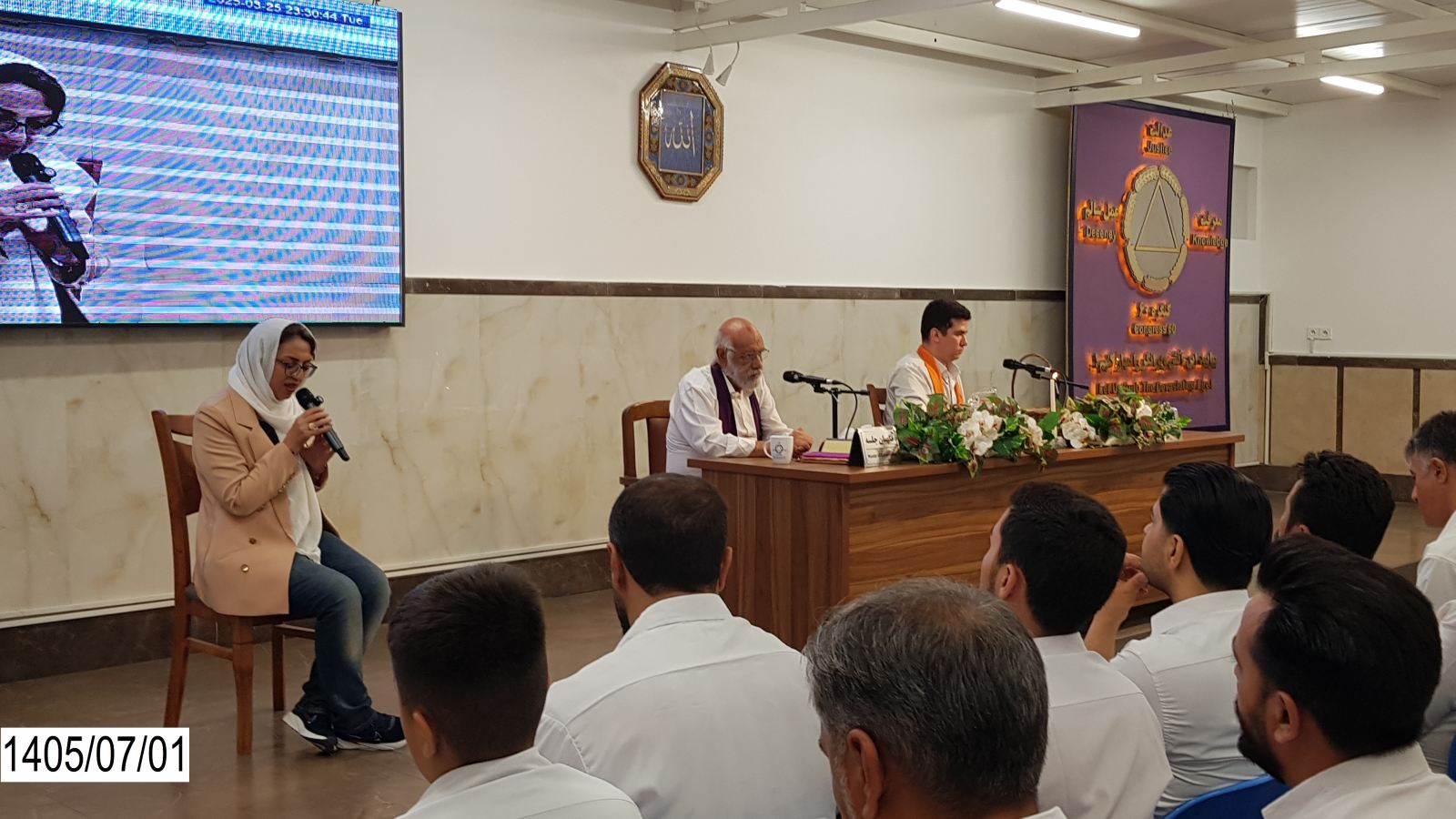
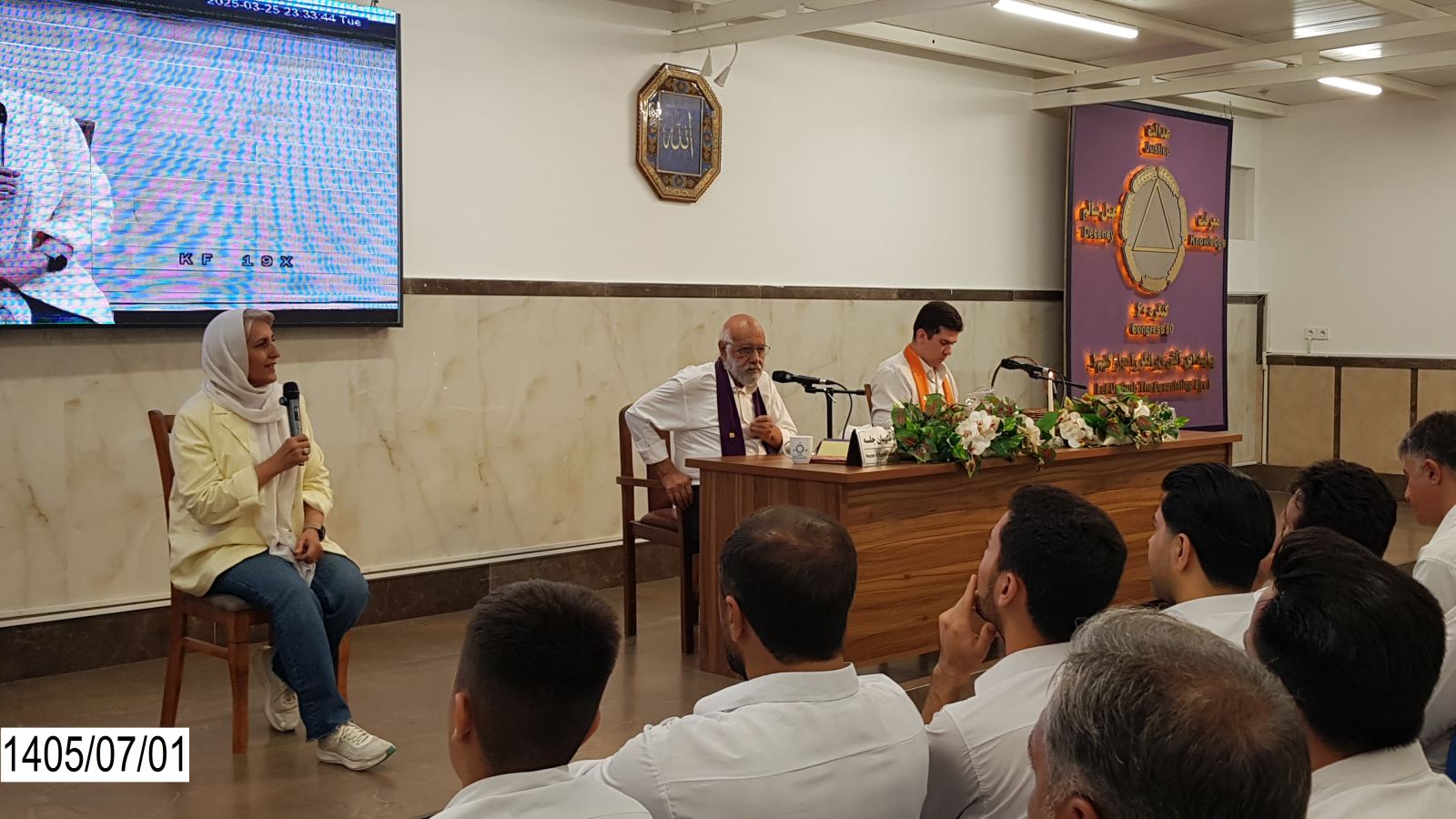
Then Master Dezhakam invited Miss Elahe, the agent of the English website of Congress 60 to stage, to give her the gift for the Site Week. After her participation, Master Dezhakam called Mrs. Marjan Moradi to speak and share her ideas in this regard.
Companion Marjan (the Boarder Guard for Congress 60’s translation website):
Hello, everyone. I’m Marjan, a Companion.
I’d like to wish you and everyone serving in this section a happy Website Week, even though I’m a little late in saying it. You, Master Dezhakam, spoke about a complete truth that can never be changed, and something that has happened for the first time in thousands of years. You spoke about the honor and dignity that have been given to OT (Opium Tincture) through your efforts and by the grace of God. I sincerely congratulate you on this.
As for what is happening in the website section, the work you have done and the words you have spoken—words that are nothing but the truth—are now being shared by the website team. I’m just a small servant in this section, and I’m very happy that you gave me the opportunity to serve here. I’ve learned so much from everyone working in this section.
The greatest thing I’ve gained from this is that I’ve come to understand the knowledge of Congress 60 much better, and I’ve been able to take a small step toward sharing this knowledge with others.
I’m very grateful to God, and also to you, Mr. Dezhakam, for always supporting us. I have always considered you our benefactor, and I hope you will be with us for many, many years to come, so that we can continue to serve. Thank you very much.
Translated by companion Sepideh, Legion 22, Sheikhbahaei branch of Congress 60, Isfahan, Iran

Revised by Elahe
https://congress60.org/News/519987/%DA%A9%D8%A7%D8%B1%DA%AF%D8%A7%D9%87-%D8%A2%D9%85%D9%88%D8%B2%D8%B4%DB%8C-%D8%AC%D9%87%D8%A7%D9%86%E2%80%8C%D8%A8%DB%8C%D9%86%DB%8C-%D8%B5%D9%88%D8%B1%D8%AA-%D9%85%D8%B3%D8%A6%D9%84%D9%87-%D8%A7%D8%B9%D8%AA%DB%8C%D8%A7%D8%AF