In the Name of God, the Most Compassionate, the Most Merciful
With strength drawn from the Absolute Power of God, we begin this session.
Hello, friends. I am Hossein, a traveler and the session guardian.
(Audience responds: Hello, Hossein!)
I kindly ask everyone to observe fourteen seconds of silence to seek refuge in the Almighty and free ourselves from our greatest enemy—our own ignorance and unawareness.
(Fourteen seconds of silence observed)
Thank you, friends. I now request our esteemed secretary to provide a summary of the previous session and announce today’s agenda.
The secretary: Hello, friends. My name is Shahin, and I am a traveler.
(Audience responds: Hello, Shahin!)
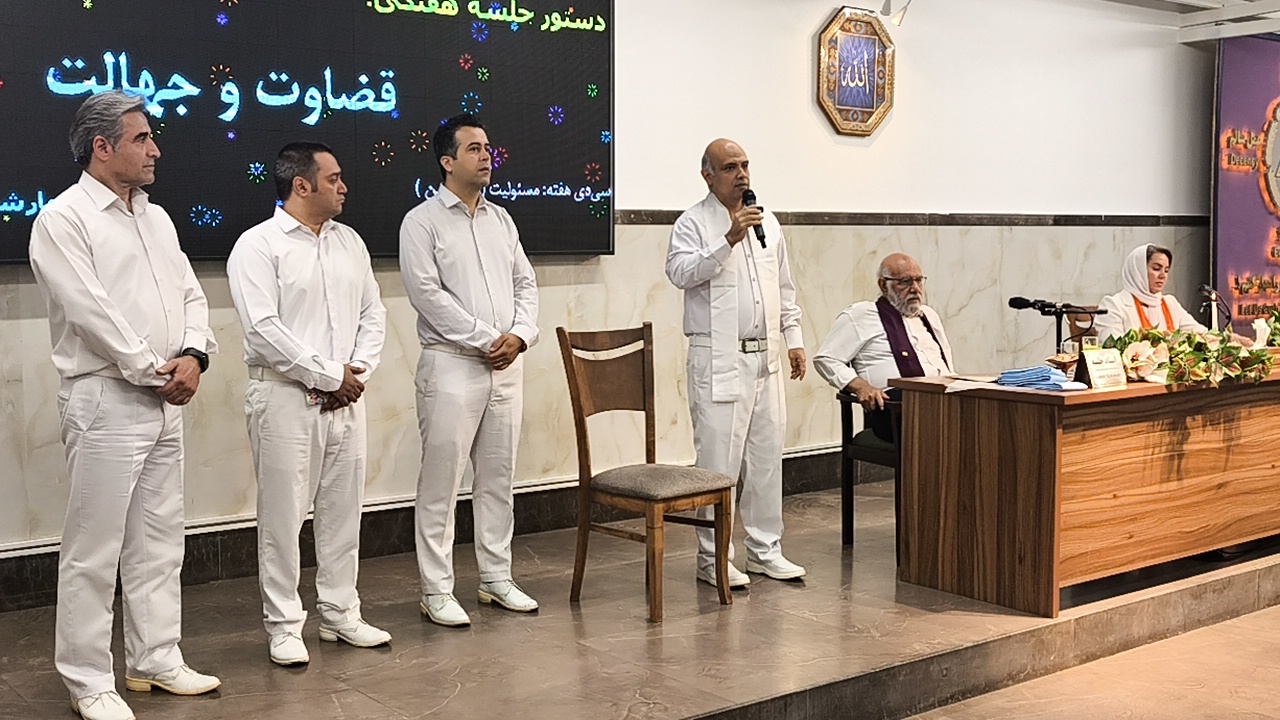
In the name of the Absolute Power of God, today the sixth session of the 87th round of Congress 60 workshops—dedicated to both travelers and companions—dated June 17, 2026 is held with the agenda “The Fourth Valley (in vital matters, leaving the responsibility to God means neglecting one’s own responsibility) and its Effect on Me”. The session started under the guidance and supervision of Mr. Dezhakam and me Shahin as the secretary at 09:50 a.m.
(Audience applauds)
Mr. Hossein Dezhakam: Thank you, thank you to the secretary. Hello friends, I’m Hossein, a traveler.
I hope you are all well; by the grace of God, I am fine too.
This is the first Academy branch session that we’re holding here at the Simorgh Building. We were in previous building [belonging to Anti-Narcotics Headquarters] for about 25 or 26 years – I think since 1998. But the authorities urgently needed it, as most government buildings had been damaged during the war. Fortunately – very fortunately – we had other buildings, so we were able to hand the building over to the Anti-Narcotics Headquarters, without any difficulty. Some members said, "We have so many memories in that building." I said, we have plenty of memories from this planet too—but one day, we'll have to leave it behind [and go to the hereafter].
When we went through that difficult period and the Academy building [belonging to Anti-Narcotics Headquarters] was sealed off [because another NGO had filed a complaint against Congress 60], we faced a lot of problems. But we learned from it. What felt like a curse at the time turned out to be a blessing. Back then, the Academy branch was the only place we had. When it was shut down, we were left with nowhere to go—we had to gather out on the sidewalk. That experience made it clear to us that we should never rely on a building that didn’t belong to us. From then on, whenever we had spaces [in other cities] provided by the municipality or other organizations, we gradually gave them back and instead rented, leased, or bought our own places. In the end, we stood on our own feet.
What I mean is that whenever problems arise, we should try to see them as a blessing so that we can reach a solution. That’s very important. Even now, we’re here, but we’re still in the process of buying another building. We’re planning carefully and weighing our options—deciding where we should be and where we shouldn’t. The hall we’re in now used to let noise escape through the windows and doors, which caused disturbance to the neighbors. Although the building is officially classified as office space, we also obtained an administrative permit for it. When we bought this building as the central headquarters of Congress 60, we wanted to make sure there would be no future problems or complaints from neighbors. So at the time, we paid—if I remember correctly—close to two billion tomans (about 10300 USD) to secure the official administrative permit.
Even today, when I came here, I asked for the windows to be kept closed—these small-pane windows—so that no sound can possibly go outside. There’s also a door there, and I’ve asked for a second door to be installed, so that no noise escapes. The point is that whenever we come here and hold a session, we should make sure we don’t disturb the neighbors or create any problems. We shouldn’t park our cars in front of people’s shops or houses, we shouldn’t gather outside, and once we leave, we shouldn’t stand at the corner chatting—we should leave the area immediately so that we can continue our work here in peace.
Today’s agenda is the Fourth Valley, which is a very important and decisive Valley. It defines our relationship with God, saying that “in vital matters, leaving the responsibility to God or entrusting things to Him means neglecting one’s own responsibility”. This is a very important point. I took a look at the first page of this valley in the book "Love, 14 Valleys to Know Thyself", and I felt it is really worth reading it to you:
“In this valley, we will try to define, as clearly as possible, the boundaries between the role and responsibility of the Supreme Power (or God) and our own role and responsibility in dealing with the vital matters of our lives.”
Here, we use the phrase "God or the Supreme Power" because not everyone believes in God. Some people simply believe in a higher power or the power of the universe. That's perfectly fine—we're not here to argue over labels. Whether you call it God, the Supreme Power, or something else, we're talking about the same thing: whatever you believe to be the greater force beyond yourself.
“This is because each of us may have a different understanding of, perspective on, and way of communicating with God or the Supreme Power—the force that governs the universe.”
Each of us may have a different view and understanding of God.
“In the Valley of Contemplation, which includes the First, Second, and Third Valleys, we came to realize that we must bear the greatest responsibility for our own lives.”
The First Valley teaches that all structures begin with contemplation; without contemplation, whatever exists gradually falls into decline. The Second Valley reminds us that no creature comes into existence without a purpose, none of us is worthless even if we believe we are. The Third Valley teaches that no one can care for, think about, or help a person more than they can themselves. In other words, no one has a greater responsibility for our lives than we do. We need to truly understand this. As an old Persian saying reminds us, the bowl never becomes hotter than the soup it holds. In other words, no one can be more concerned about our lives than we are ourselves. We must learn that we are the ones who care most about our own being. We are the ones who shape our lives, and we must recognize that responsibility. This is the point the Fourth Valley now goes on to make.
“Now in the Valley of Contemplation, which includes the First, Second, and Third Valleys, we came to realize that we bear the greatest responsibility for our own lives. Yet there may still be another escape route.”
We have learned that the responsibility for our lives rests with us. Yet there may be one escape route—a hidden opening where we can easily fall into the same trap as we try to avoid that responsibility. What is that escape route? “Yet there may still be an escape route through which we try to shirk our own responsibility. This is indeed a way for us to avoid taking responsibility for ourselves. And that escape route would be to put the full responsibility of our lives on God, presenting it in a self-righteous way as a symbolic, divine, or mystical act of generosity and nobility.”
Its meaning is that for some people it seems that it is a virtue if they put their responsibility on God, we even become self-righteous about it. We considered this as a symbolic, noble, even divine act of generosity. In other words, we hand over the responsibility for our lives to God and then congratulate ourselves for being so wise and enlightened, saying, "God, we are entrusting it all to you," as though we were offering Him a priceless gift. “We hand over the responsibility for our lives to God and then, out of laziness and idleness, simply sit back, do nothing ourselves, and expect Him to solve our problems and correct our character flaws.” We do this out of laziness—we simply sit back and expect God to solve our problems for us. [We deceived ourselves by saying these words to God:] “You are great. You are all-powerful. We place everything in Your hands and expect You to solve our problems, remove our difficulties, heal our illnesses, and make up for our failures.”
“We hand everything over to God and expect Him to do it all for us – to solve our problems, pay off our debts, free us from addiction, and take care of everything else. Do we really think God exists so that, if we have buried ourselves in debt through our own negligence or laziness, He will simply open His unseen treasury—or take money from someone else—and give it to us? Or that if I commit a crime and end up in prison, God or some higher power is somehow responsible for getting me out? Or that I can sit back and do nothing while someone else provides for my wife and children? And there are countless other situations like these, where we expect God to step in and solve the problems we have created ourselves.”
It says that even after we accept responsibility for our lives, one escape route still remains: we try to hand that responsibility over to God. We tell ourselves, “as the Persian saying goes, ‘The one who gives us teeth will also give us bread’—God will provide whatever needed because He has created us and gave us teeth, and everything I need to eat, is provided by God. God, You take care of all my problems.” Then we convince ourselves that this somehow makes us more spiritual—that we are mystics, Sufis, or deeply enlightened people simply because we have placed the burden of responsibility on God. But the text says, “That's not how it works.” God has entrusted us with responsibilities of our own. That is why we are here, living on this earth. We have our responsibilities, and God has His. So how can we expect Him to carry out the duties that belong to us?
Human beings are often quite naive. At times, they turn to God expecting Him to solve their biggest problems at the lowest possible cost. They say, for example, “If You solve this problem for me, I will sacrifice a sheep,” or “If You cure my cancer, I will donate to an orphanage.” These kinds of bargains are constantly being made. A problem that may require billions to treat or resolve is reduced to the promise of a sheep or a few candles offered in return. But it doesn’t work like that!
This valley says that we must take responsibility for our own lives. We can trust in God, surrender to Him, and pray to Him—and our prayers may be answered—but only if we also take action. This should not mislead us. All of this is fine, but only when we move and act ourselves. We should say, “God, I will do my part; You give Your blessing.” As the saying goes, “Do your part, and God will help” “God, I will study with all my effort—please help me.” “God, I will work as hard as I can—please support me.” And God is, as it were, pleased with this. But it is not about putting the burden of our lives on someone else.
I wrote the Fourth Valley because of certain self-managed addiction recovery NGOs that existed, which placed all responsibility on God. In their own Steps, they had shifted the burden of responsibility onto Him. They constantly asked God to remove their shortcomings. But God does not remove our character flaws, and He is not there only to solve our problems. I have said many times that we should not think of God as an old, white-bearded man sitting somewhere above us, judging people, granting some people's prayers while refusing others’. That is not the right way to understand God. God has designed a vast system that operates on its own. If you plant wheat, you harvest wheat. If you plant barley, you harvest barley. You reap what you sow. If you hurt others, you will be hurt in return. If you do good, good will come back to you. If you do harm, you will receive harm. That is simply how this system works. That is the whole point of the Fourth Valley: if we truly want to change ourselves, we must rely on our own thinking, our own judgment, and our own effort. We can ask God for help, and we should, but we cannot hand over our responsibility to Him. We cannot simply say, “God, take away my character flaws.” How could He, if we are not willing to change ourselves? It's like signaling left and then turning right—or signaling right and then turning left. If we act one way but expect a different result, how can we expect God to put things right for us?
So that’s really the essence of the Fourth Valley. By now, you’ve already read the chapter, and you can also listen to the audio file if you want to go over it again. The main idea is that everything up to this Valley is about learning how to think properly. It is in the Fifth Valley that we start putting things into practice. Up to here, we’re the ones who have to do the work, step by step. Above all, we need to rely on ourselves. Support from others is valuable, and God’s help is invaluable—but in the end, we are at the center of this process. Thank you all for listening. I really appreciate it.
Translated by companion Sepideh, Legion 22, Sheikhbahaei branch of Congress 60, Isfahan, Iran

Revised by Elahe