In the Name of the Absolute Power, Allah
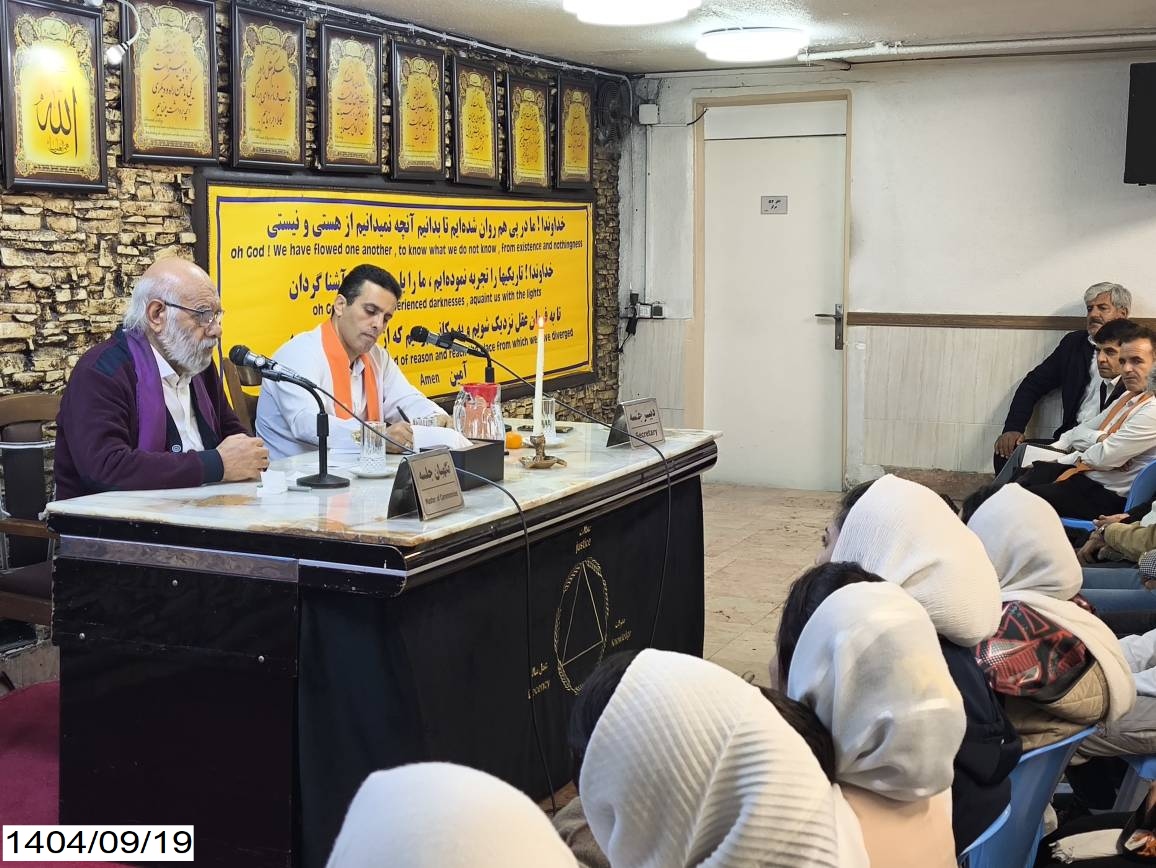
The tenth session of the 86th series of Congress 60 educational workshops, dedicated to travelers and companions, with Mr. Hossein Dezhakam serving as the master of the ceremony and the guardian, and traveler Farshad as the secretary, with the agenda “How Do We Express Appreciation in Congress 60?”, started at 10:00 a.m. on Wednesday, December 10, 2025.
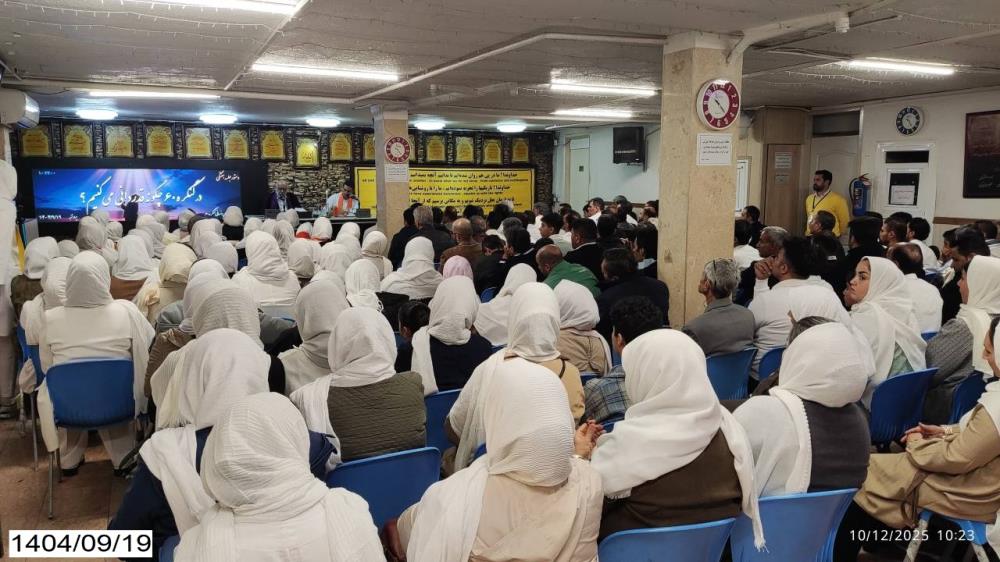
Hello friends, I’m Hossein, a traveler.
I hope you’re all doing well; thank God, I’m doing well too. Today is the 19th of Azar, 1404, and the time is 10:24 in the morning. We are in the Academy building in Tehran. Fortunately, it’s raining across many areas, which in itself is a blessing and a sign of God’s mercy.
If the session started a bit late today, it was because there was a possibility that it might not be held at all. Early this morning, the street was being dug up for sewage repairs, and apparently an electrical cable had been cut. We thought the session might be canceled, but thankfully the power came back within a minute or so, and we were able to hold the session after all.
Well, the agenda for today is “How do we express appreciation in Congress 60?” Before I get into that discussion, I want to say a few words about OT syrup.
As you know, the country is going through special circumstances. We see water cuts, electricity outages during the summer, gas supply issues, air pollution, a lack of rainfall, and a significant drop in the water levels of dams. Fortunately, measures have been taken, and up to now the supply of OT has not been disrupted. OT was available before, it is available now, and it has not even become more expensive. Despite shortages in many areas, thankfully the opium tincture syrup has remained accessible. The Ministry of Health, the Anti-Narcotics Headquarters, and other government bodies have all worked together so that, up to this moment, the syrup has been provided to everyone who needs it.
Recently, however, some shortages have emerged in obtaining OT syrup. This is because the pharmaceutical factories that produce OT relied on confiscated illicit opium. The seized opium would be stored in warehouses and then supplied to pharmaceutical companies, where it was processed into syrup. In some cases, opium was also imported from outside the country, including from India. In any case, opium seizures have decreased. If I’m not mistaken, for example, last year they might have seized around 1,200 tons of opium, while the following year that number dropped to around 400 tons. Suddenly, the overall volume fell, and as a result, there has been some shortage of opium. Because of this, the quota for some clinics has been reduced.
Even so, most clinics have done their best to provide OT syrup as a medication. What I want to emphasize is that this is not a serious or alarming issue. There is no need to panic or refuse admissions. When people come for admission, accept them. If they ask, “What about OT?” you can say: if OT is available and the clinics have it, we will tell you to go and receive it. If it is not available, we still accept you and tell you to obtain your own OT.
Now, how you obtain it and what you do is up to you. OT is not something strange, frightening, or extraordinary. It’s not like a heart medication or insulin that cannot be prepared. It’s simply opium, water, and alcohol. It’s not complicated, and it’s not a major issue.
What I mean is that we should not panic or become frightened about this issue, and neither should your pupils. After all, how were you getting opium when you had been an opium user for 20 years? Or for 30 years? If you were using heroin, where did you get the heroin from? Where did you get drugs from in general? Well, now it’s the same, go and get it from wherever you used to, on your own responsibility. We have no involvement in that. God willing, the situation will be resolved.
My point is that we have gone through many ups and downs to reach this point, and we will continue to move forward after this as well. This is just a passing phase, like a sudden rainstorm, it comes, pours down, and then it passes. The government is fully engaged in addressing the issue; everyone is making an effort. The Secretary General of the Anti-Narcotics Headquarters is working on it, others are working on it too, trying in every possible way to supply and import opium. That’s why there has been a temporary reduction.
However, many clinics are still providing opium syrup, and there is no serious problem. So the main issue is this: we must not panic, and we must remain calm so that things can move forward smoothly. This is just a storm, a sandstorm, that will pass and move on.
The CD that will be released on Saturday is titled “Shortage,” and it mainly addresses this very issue of OT, what we should do and how we should handle it. That is why guides need to educate their pupils on what to do; they already know what to do. In the past, when Congress 60 first began its work years ago, we worked with raw opium for ten years. There was no OT syrup back then. Later, the government introduced this system. At that time, individuals simply reduced the same opium they were using, step by step, according to a plan, until they eventually reached zero.
Now, for example, when we say a daily dose of 0.3 cc of OT, that is equivalent to one-thirtieth of a gram of opium. Even now, good-quality opium can still be found on the market, so don’t worry too much (laughs). Very good Iranian opium is available; in some places it has even been cultivated illegally in the mountains, and its morphine content is high, it’s good-quality opium. So there is really no cause for concern at all.
The reason I really wanted today’s session to be held was precisely to convey this message to the members: this situation exists, but it is not important. We have gone through far worse, much harder, and far more complicated situations than this. Compared to those, this is nothing.
When I thought about it, I said to myself: look how interesting this is, milk becomes more expensive three times in a single week, but opium has not increased in price for years, and OT has not become more expensive either. There has been no real shortage. So you can see that, on this side, fairness has been observed very thoroughly.
Be sure to watch my interview on the website, where I spoke about this issue, about poppy cultivation. From the very beginning, for many years now, I have always been in favor of opium being cultivated inside the country. In fact, it is necessary; it is one of our essentials.
In that interview, I said: can you believe that France grows opium? That the Netherlands grows opium? That Australia grows opium? That Turkey grows opium? Hungary grows it? India grows it? All of these countries cultivate opium. Even the United States grows opium. Has the number of opium users increased in those countries? Have addiction rates gone up? No.
It’s not only about consumption anyway. Of the total opium produced, perhaps 10 or 20 percent is related to consumption, while about 80 percent, I don’t have the exact statistics, is sent to pharmaceutical factories, where morphine is extracted, codeine is extracted. Opium contains between 3 percent and 23 percent morphine; that’s where morphine comes from. It also contains around 0.3 to 3 percent codeine, which is also extracted from opium. From it they obtain noscapine, papaverine, thebaine, and many other compounds. It is a completely strategic medicinal substance, cultivated in the most advanced countries in the world.
This idea that we should panic and say, “If opium is cultivated, everyone will become an opium user,” is simply not true. Who said everyone would become an opium user? Even before the Revolution, opium existed for thousands of years. It was legal; there were even places like traditional opium houses, similar to coffeehouses. Did everyone use opium back then? No.
So, from the very beginning, I have believed that opium should be cultivated in the country and used for medical and pharmaceutical purposes.
The opium that is cultivated in Iran has a very high morphine content, excellent quality, and highly valuable derivatives. There is one type of opium that contains 0.3 percent codeine, and another that contains 3 percent codeine, meaning ten times more codeine. There is opium with 3 percent morphine, and there is opium with as much as 23 percent morphine. The opium that used to be cultivated in Iran was of very high quality.
In addition, in agricultural terms, opium cultivation requires very little water. Moreover, when opium is cultivated on a piece of land, that land becomes resistant to agricultural pests for years. If opium is planted in a field for just one year, that land will remain free from pests for seven, eight, even up to ten years. It is such a powerful, effective, and valuable medicinal plant.
We are hopeful, and the government is also actively working toward this, that this cultivation will be carried out again. Therefore, you can go to the website and read the statements I made there, refer to the original source, and if possible, share and repost it as much as you can on social media, so people become informed and understand what needs to be done.
The government, with considerable effort, is trying to ensure that the Ministry of Health can rebalance the situation and compensate for the shortages as soon as possible. These measures are underway, and the relevant headquarters are also actively working on this matter.
God willing, we should make sure that accurate and precise information is conveyed.
One important point is this: some people say, “Well, if opium is not available, we’ll just use methadone.” Methadone is useful for harm reduction, I’m not saying it is bad, but it is not suitable for the treatment of addiction. Yes, for someone who is homeless, injecting, and in a very critical condition, methadone can be very helpful. But for you, we have tested and examined this thoroughly.
We tested opium, fentanyl, and amphetamines on laboratory rats, each substance on two rats. We then took the results to England and evaluated them using microarray technology. We also conducted human studies. When you compare DST and OT with methadone, you see effects that are so severe that one can hardly even describe the extent of the damage.
This can all be tested and demonstrated. We can treat one group with naloxone, another with methadone, another with B2, and then treat another group with opium tincture (OT), but OT by itself is not acceptable. What is acceptable is opium tincture with the DST method: starting from a specific dose and gradually reducing it over, for example, ten months, until it reaches complete cessation, along with reconstruction of the nervous system.
In the system we tested, with OT and the DST method, the entire nervous system was rebuilt. The dopaminergic system, which is responsible for vitality and joy, was in excellent condition. The serotonergic system was excellent. The immune system was fully restored. Even the mitochondria, the cell’s power plants, were in excellent condition.
But when we tested other substances, which I prefer not to name here, even though those methods had also led to “cessation,” the results were alarming: the mitochondrial power plants were severely damaged, the dopaminergic system was completely destroyed, and the serotonergic system was devastated.
These are not things one can just claim casually. You cannot simply say, “This is good, that is bad.” We must speak in academic language. We must say: “We conducted this experiment, using this substance, and these were the results.”
Fortunately, we took blood samples from the human subjects, and in the animal studies we extracted cerebrospinal fluid, brain tissue, and examined everything, where? In England, at Cambridge University and Bristol University. They fully evaluated how our 18,000 to 20,000 genes were affected:
Are they regulated?
Are they re-regulated?
Has health been restored or not?
Is life expectancy normal?
Is the immune system strong?
Is the body resistant to disease or not?
This is how we must speak. If we simply say, “This is good” or “That is bad,” No, absolutely not. We have one language, and that is the scientific language. And scientific language means laboratory work, research, and documented studies.
Fortunately, such technologies do exist, although, unfortunately, we do not yet have them in Iran. God willing, we will eventually be able to import them for our own laboratory. These are devices that can examine all of an individual’s genes, around 20,000 genes in total, covering everything: the cardiovascular system, the kidneys, the bladder, and all other systems of the body.
You must see whether the medication you prescribe is truly beneficial or not. Sometimes you prescribe a drug for a patient’s kidneys, but it causes their hair to fall out. Then you tell them to go to a dermatologist to get medication so their hair won’t fall out. Or the drug causes frequent urination, so now they have to see a urologist. It raises blood pressure, and you warn them: “While taking this medication, do not drive, because it causes dizziness.”
Today, we must examine this carefully: when a drug is prescribed for an eye condition and improves the eye, does it cause harm elsewhere in the body or not? When you prescribe a drug for the ear, does it treat the ear without damaging the heart, lungs, or brain?
Therefore, the first principle in medicine for any drug that enters clinical use is this: before even asking whether it solves the intended problem, we must first determine whether it harms other parts of the body. Only then can it receive approval.
Now we must ask these same questions:
When we use naltrexone for the treatment of addiction, does it damage other systems of the body?
When we use methadone, does it harm other organs?
When we use B2, does it cause damage elsewhere?
When narcotics or opium are abruptly discontinued, does that sudden cessation harm other systems of the body?
All of these issues must be carefully evaluated. Only then can we speak about them.
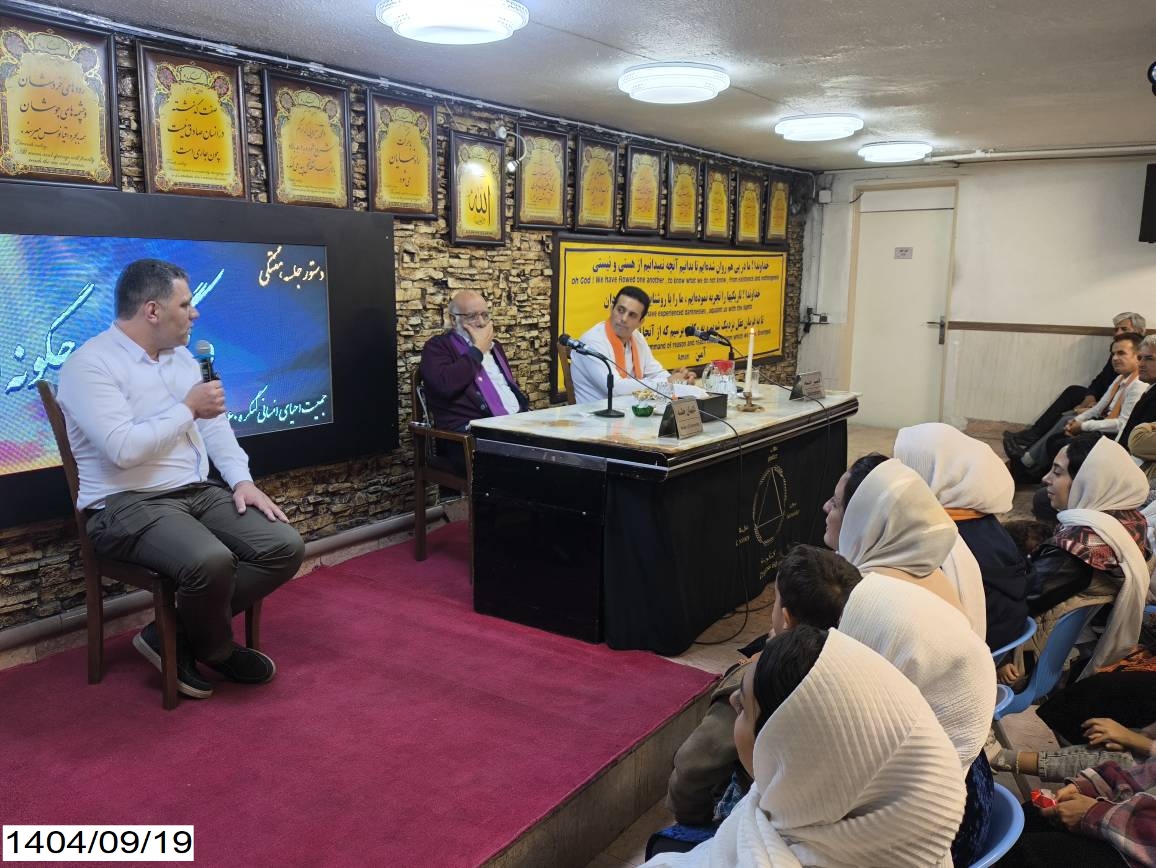
At present, we are actively participating in major international conferences. There were two major conferences in Boston focused on addiction, and I was invited to both and personally delivered lectures. One was held from October 20 to October 23, and the other from October 23 to October 26, roughly within that time frame. I attended both conferences and presented our work, by their own invitation, because they are reading our articles. As I mentioned before, we now have 50 to 60 invitations from various conferences asking us to come and speak, because they have seen our experiments, our work, and the results of our research.
Therefore, if we say, “Well, since OT syrup is not available, let’s go and use some other medication and treat people with that,” this is simply not the same thing. These approaches are fundamentally different, and we cannot achieve the same results. The reason is that there is something in opium that does not exist in any of those other substances. Opium contains between 25 and 50 active alkaloids, and we are clearly observing their effects among our members.
In fact, even globally, the very concept of treatment, real treatment, is something that many people still do not believe in. Naturally, it takes time for this understanding to develop and for belief to form, gradually and step by step.
The next topic we have is: “How do we show gratitude?” Now, the discussion isn’t limited to how we show gratitude specifically in Congress 60. The concept goes back much further. As our elders used to say: “If you are thankful for a blessing, it will increase; if you are ungrateful, it will be taken away.”
Gratitude, is simple, it just means thankfulness. It’s not complicated. For example, in everyday life, you give a cup of tea to someone: one person receives it with a smile and says, “Thank you, much appreciated,” while another person complains about the tea, criticizing it. You give food to one person, they express gratitude; another person might say it smells bad or doesn’t taste good. What do you do next time?
Hatam Ta’i had a servant whom he loved dearly. One day, he cut a melon and gave a piece to his servant before he ate any himself. The servant ate it and said, “Mmm, this is so sweet and delicious!” He ate it with so much delight that Hatam gave him another piece, and again he expressed his joy and gratitude. Finally, only one piece remained for Hatam himself. When he ate it, he found it extremely bitter. Hatam asked, “Why didn’t you say anything when it was so bitter? You ate it all so cheerfully!” The servant replied, “Throughout my life, you’ve given me so many things, and they were all good. Now that one piece is bitter, should I complain? You gave me hundreds of good things; one bad one shouldn’t overshadow all the rest.”
This is exactly what gratitude means. Are we like this? If we receive a hundred good things and one bad thing happens, how do we react? Expressing gratitude is thankfulness.
We all naturally like people who are grateful. For example, if you’re driving a taxi and a passenger gets in and, when leaving, politely says, “Thank you, much appreciated,” closes the door properly, and hands you the money with a kind word, it gives you a tremendous sense of satisfaction.
It’s the same in a family: when you cook, clean, or do chores, and your family says, “Thank you, much appreciated, you worked hard,” it motivates you. You feel joy, and next time, you want to prepare a better meal or provide even more care.
But when people take without acknowledging your efforts, like livestock in a barn, consuming the food without any recognition, you naturally feel discouraged. Next time, you may give less effort or stop trying altogether.
So, it’s extremely important to practice gratitude at all levels of life, not just in Congress 60. Be grateful to yourself, to God, to the universe, to the beauty around you, and to all the blessings you’ve received.
If you have thousands upon thousands of problems, but suddenly someone tells you that you have an illness and you will die in one month, all those problems instantly fade away and lose their importance. Nothing remains except your health, and you realize how incredibly valuable it is.
You may be facing countless problems and crises that seem impossible to solve, but the moment you’re told, “You have a serious illness; you have only one month left,” everything else loses its meaning. Only health matters. This health we have is a truly precious gem, yet as long as we have it, we don’t realize its value. The moment we lose it, only then do we understand what it really meant.
The same is true of the people around us. We often fail to appreciate them while they are with us, and only realize their value when we lose them. A father in the family, his value is not fully understood until he is gone. A mother is the same. A sister, a brother, a friend, many companions are the same way. As long as they are present, we don’t truly recognize their worth; it is only after losing them that we finally understand how valuable they were.
In Congress 60, how should we show gratitude? Gratitude and thanks should be expressed in three ways:
1. With the heart: If you take a taxi, you should genuinely feel grateful to the driver. Even if you gave the fare, the driver still brought you safely to your destination. If someone offers you a cup of tea, the same principle applies. In school, if a professor teaches you, plotting against the professor or harboring ill will doesn’t harm them, it harms yourself. The same happens in your Legion; being resentful toward your guide or teacher only hurts you.
2. With words: Gratitude must also be expressed verbally. If you care about someone, you should tell them. Some people think that feeling gratitude in their heart is enough, but you must also express it with words.
3. With action: The most important way to show gratitude is through action. Words and feelings alone are not enough. For example, consider the story of a man crying over his starving dog. When asked why he cried, he said it was because the dog was dying of hunger. He had bread in his bag but refused to give it to the dog, saying he could only cry. He expressed gratitude with his heart and his tears, but he did not act to save the dog.
This is exactly like our situation: we may feel grateful, even say thank you, but if we don’t act, if we don’t contribute or give back in practice, our gratitude is incomplete. Fortunately, the members of Congress 60 have understood this principle very well under our guidance. Thank God, Congress 60 was established at the right time.
In the early days, our trainings were on cassettes. Some of you may remember that when we wanted to record a cassette, it would take an hour just to fill one. We had five machines, each with its own recorder, and Mr. Hakimi used to fill the cassettes. At first, it worked fine, but as demand grew, it became impossible to keep up. Then CDs came, and we had machines that could produce a hundred CDs every five minutes, and we had to transport them with a van to distribute and empty the stock. That phase passed, and then the app arrived, making everything much easier.
This is the technology that has helped us, and we took full advantage of it. It is these CDs that provide our training, connecting everyone together. Through these teachings, the members of Congress 60 have fully learned how to show gratitude. The majority of our members, whether they are in the Sardar Legion, the Pahlevans’ Legion, or the Donners’ Legion, are actively helping others, supporting Congress 60, and practicing gratitude and thanks.
Because of this collective effort, we have been able to stand firmly on our feet and continue our work. Each member does what they can with full willingness and desire to serve others. This process is a beautiful cycle: God has given us the opportunity to serve others, and in serving, we find inner peace, joy, and comfort ourselves.
Amin used to say something very insightful. He said: If what’s inside us is ruined, we try to ruin the outside world as well. But if what’s inside us is sound and healthy, we want to make the outside world sound and healthy, too. This is exactly the idea of inhabitants of prosperity versus inhabitants of ruin. Those who are inhabitants of prosperity will turn any place of ruin into a place of growth and order.
You can see it clearly with the members. For example, they go and rent a garage for Congress 60, and before even a month has passed, you see the place completely transformed, painted, repaired, organized. Sometimes I even tell them, “Please don’t fix it up this much,” because the owner might come, see the changes, and then triple the rent, or say, “Leave, I want to turn this place into a restaurant.” Wherever they set foot, they immediately bring order and prosperity to that place.
This in itself is something to be grateful for. Some members even come to Congress and ask to serve in the position of Pahlevan, to take on that role, and I don’t give them permission. They say, “We want to help,” and I tell them, “No, not yet, you shouldn’t be helping at this stage.” What I mean is that some people are so far ahead in their willingness and readiness to serve.
Now, the first and simplest way to show appreciation in Congress 60 is by respecting one another and valuing each other. Want to show gratitude toward Congress 60? When you talk to a Marzban, treat them with respect and listen carefully to what they say. Want to show gratitude? When your guide speaks, listen and put their advice into practice. Want to show gratitude as a guide? Arrive on time at the meetings, don’t come late, and don’t leave early.
If you want to show gratitude, your behavior toward the members must be kind and compassionate. If you are an agent, Marzban, or Watcher, don’t speak sharply or harshly to people. Speak with patience, with understanding, with tolerance; don’t get angry, and don’t use a biting tone. Avoid harsh or hurtful language, some people speak in a way that feels like they are stinging others with their words, and we must not do that.
This is one form of showing appreciation: never hold grudges or expect something in return. Whatever someone does, they shouldn’t expect a reward or favor in return. If someone wants to donate to Congress, think of it as tossing the money into a river, expect nothing in return. No requests, no demands, not even from God. If you approach it with expectation, it becomes a business transaction, a trade, a form of “shopkeeping.” You can’t say, “I’ll do this, but you have to do that; I’ll bring the nuts, you bring the rice, and we’ll cook it together.” That’s not how it works.
When you give freely, without expecting anything, that is when you truly gain. When you give with an open heart and no expectations, God helps you in ways that feel like magic, you may walk through fire and emerge in a garden, or step into a garden and find yourself in fire. When you operate this way, with generosity and no expectation, you achieve everything, and God gives you everything.
Otherwise, if you give and expect something in return, saying, “I’ll make this donation, now give me this in return, or grant me that position”, it’s like trading money for goods in a shop. That’s not gratitude; that’s a transaction. All your actions must be selfless, without expectation. Only then will you reach the real results.
For a lover, the account is with love, what account can there be with the beloved? At that moment, the beloved responds to you beautifully, if your heart and intentions are full of love. But as long as you expect something in return, you won’t reach the result. What I mean is this: we should do things without expecting anything back. We should serve, help others, and contribute without any expectation of reward. If we reach this level, we will certainly succeed.
So, showing gratitude to Congress 60 means respecting others, respecting your guide, respecting the Marzban, respecting the members in your legion, and respecting those who are suffering or feeling down. Speak kindly to them, offer a word of warmth and compassion. Speak gently and kindly to everyone around you. That, in itself, is a form of gratitude, to others and to God.
Thank you all for paying attention to my words. I truly appreciate it,thank you, thank you so much.
I want to share an interesting point with you. One of the members said: recently, Trump, yes, everyone knows Trump, of course (laughs),he ordered that overweight people should not be accepted. That is, anyone who is overweight and wants to be admitted, they just don’t accept them.
Now, we’ve been dealing with this issue for several years, three, four years, and not that we got this idea from him (laughs). Even in the army, anyone who was overweight was removed. The point is that obesity is a disability, and people need to understand that. All overweight people should listen carefully: obesity is a disability.
Fortunately, and I truly mean fortunately, there is a solution here at Congress 60. If there wasn’t, I wouldn’t say it so openly, because some people would get upset, and then go for gastric surgery, cutting parts of their stomach or intestines to lose weight. But now, the solution is as simple as drinking water. Obesity is simply a matter of not knowing how to eat properly, not eating too little, but eating correctly.
Because of this, obesity is considered a disability, and it must be addressed. When someone has 30 or 40 kilos of extra weight, it’s a real disability. It’s no joke, they are deprived of so many things. As Amin also said, every extra kilo you carry adds a year to your age. So, if you have 30 kilos of extra weight and you are 30 years old, your body functions like a 60-year-old. Want to run? You run like a 60-year-old. Want to exercise? Like a 60-year-old. Stand up from the floor? Like a 60-year-old. Everything you do is affected as if you were 60.
This should be the approach in Iran too, factories, offices, the army, even universities. Now some authorities have said, “Don’t accept overweight people,” but they haven’t provided a solution. They just say, “Don’t accept them,” without guidance. Some suggest surgery or exercise, but as you can see, surgery causes loose skin and other problems. That’s not a reasonable solution.
Fortunately, at Congress 60, we provide a practical solution. We say: “Here’s the way. You don’t even need to spend a single penny. Go and register in the Jones Legion and reduce your weight for free.
The key is to follow the program exactly and not do anything extra. For example, if a meal is laid out with ten different dishes, just pick one or two that are best for you and eat those. That simple choice alone can make a difference.
If you try to do something extra, like counting calories, measuring protein, running, lifting weights, or searching the internet for answers, you’ll see that no one has really figured it out. The only person who has is me (laughs). I’ve discovered it, shared it with you, and now you’re applying it and seeing the results. Some people might say, “Oh, they were paid to say this,” or “They’re actors just performing,” but the truth is, it’s just about following a proper eating plan.
All the pain and suffering in our lives often comes from not knowing, ignorance. Sometimes human suffering is simply because we lack knowledge. We don’t know what to do. But if we apply knowledge that has already been discovered, the problem is solved. This is not a joke,36 kilos! They lost it without any fuss, without any struggle.
Interestingly, we’re running the exact same project in reverse, for gaining weight. We have people following this program who gained 20 kilos, 11 kilos, and many women and men who were extremely thin and couldn’t gain weight no matter what, they follow this project and gain weight.
So, if we can’t find opium, or opium syrup isn’t available, we just shift our focus, we go and work on weight loss or weight gain (laughs). We can work on smoking too. Honestly, we don’t have any problem at all (laughs).
Typed by: Companion Parvaneh
Translated by: Companion Marjan
2025/16/12
.jpg)
https://congress60.org/News/468743/%DA%A9%D8%A7%D8%B1%DA%AF%D8%A7%D9%87-%D8%A2%D9%85%D9%88%D8%B2%D8%B4%DB%8C-%D8%AC%D9%87%D8%A7%D9%86%E2%80%8C%D8%A8%DB%8C%D9%86%DB%8C-%D8%AF%D8%B1-%DA%A9%D9%86%DA%AF%D8%B1%D9%87-60-%DA%86%DA%AF%D9%88%D9%86%D9%87-%D9%82%D8%AF%D8%B1%D8%AF%D8%A7%D9%86%DB%8C-%D9%85%DB%8C-%DA%A9%D9%86%DB%8C%D9%85