In the Name of God, the Most Compassionate, the Most Merciful
With strength drawn from the Absolute Power of God, we begin this session.
Hello, friends. I am Hossein, a traveler and the session guardian.
(Audience responds: Hello, Hossein!)
I kindly ask everyone to observe fourteen seconds of silence to seek refuge in the Almighty and free ourselves from our greatest enemy—our own ignorance and unawareness.
(Fourteen seconds of silence observed)
Thank you, friends. I now request our esteemed secretary to provide a summary of the previous session and announce today’s agenda.
Session Secretary:
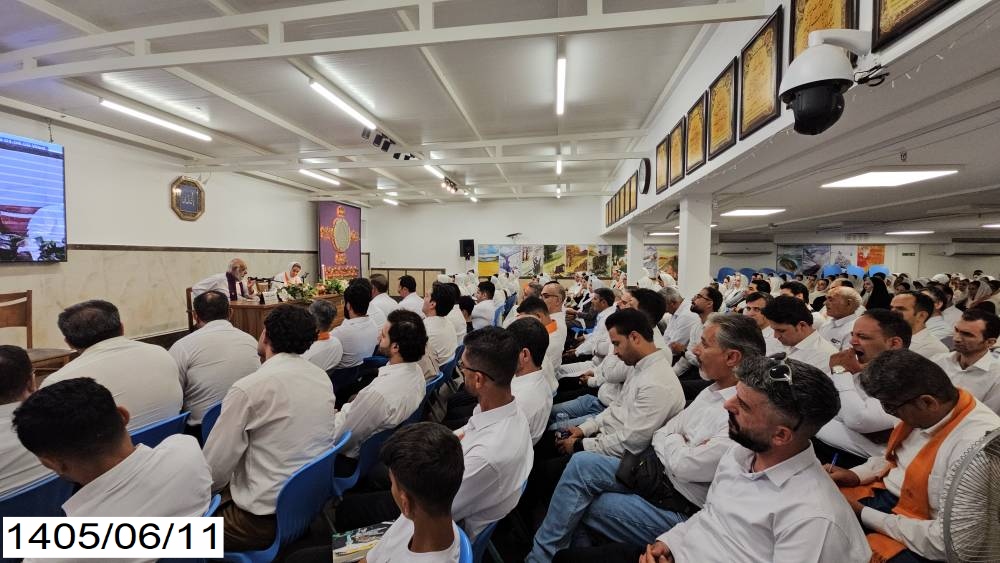
This is the twelfth session of the eighty-seventh round of the Worldview Educational Workshops of Congress 60, held for Travelers and Companions, with the guidance and supervision of Mr. Dezhakam and me Akram, as the secretary.
Today’s agenda is “From Obedience to Commandership.”
The session began at exactly 10:17 a.m. on Wednesday, September 2, 2026.
(Audience applauds)
Thank you.
Hello, friends. I’m Hossein, a Traveler.
(Audience responds: Hello, Hossein.)
I hope you’re all doing well. Thankfully, I’m doing well too.
Today is September 2, 2026, the last month of summer. Little by little, we’re getting ready to enter the fall season.
At the previous session, we weren’t able to hold the meeting. And today, we waited and waited, but the power still didn’t come back. The hall was completely dark, and even the emergency lights weren’t working. So I said, “You might as well go home.” I asked, “When will the power be back?” They said, “In about two hours.” I said, “Well, then let the others know they should leave. There’s nothing else we can do.”
And wouldn’t you know it, five minutes after I made that announcement, the power came back!
So I came back again to see if we could finally hold the session.
It’s 10:20 in the morning now, and we’re here at the Simorgh Building in Tehran.
The main issue we’re discussing today is the agenda, “From Obedience to Commandership.” There are a few points I’d like to bring up.
We’re still in Watchers’ Week. Since this is Watchers’ Week, each Watcher is expected to visit fourteen or fifteen cities and inspect the different locations to see how things are being handled.
I’ve received some reports. Overall, everything was good, but in some places, the restrooms occasionally need to be cleaned thoroughly. They have to be completely clean—both the men’s and the women’s restrooms.
In other words, whenever a group is responsible for guarding a session, once the session is over, the Guard in charge, through the secretary, must arrange for the service legion to come in and clean the place.
They need to empty the trash, clean the restrooms, and make sure everything is spotless. Everything should be completely clean.
Back when we were at the Academy, we used to wash the floor of the hall after every session. The floor should shine, the restrooms should be spotless, and the same goes for both the women’s and men’s sections.
Everything needs to be clean.
In some places, it was noticed that, for example, pieces of plaster had fallen from the ceiling, and they hadn’t been repaired. They had simply been left that way.
We have a CD called “The Broken Window.” It explains that if you notice a broken window in your home, in a factory, a company, or anywhere else, you should replace it immediately. If you don’t fix that first broken window, then another window breaks, then another one. After that, you start having problems with the pipes, the water, the walls, the ceiling—and before long, the whole place can quickly turn into a ruin.
So it is our responsibility to take care of these things.
The Border Guard should have a clear view of the entrance so that they can properly control who is coming in and going out.
There was a case where a Watcher entered a branch, and the Border Guards had no idea. They didn’t know who had come in or who had left.
For example, suppose this is the hall and our Border Guard is stationed at the entrance, but the Border Guard is sitting on the second floor. Can the Border Guard be on the second floor?
If the people are coming and going through the entrance, then what are they supposed to do?
So, the Border Guard must be positioned in a place where they have full control and a clear view of the entrance.
They also need to keep an eye on the heating system, gas, water, electricity—everything.
All the areas under our responsibility should always be clean, orderly, and in good condition.
We said that, for example, there’s no need to roll out the red carpet for the Watchers, shower them with flowers, or do all sorts of other things when they come. We’ve already said that those things aren’t necessary. But at the very least, when they arrive, you should welcome them properly.
You should go out to meet them, find out when they’re arriving and when they’re leaving, and make sure the necessary information is communicated. These are the things you need to do.
Sometimes, we’re so worried about not falling off one side of the roof that we keep backing up until we end up falling off the other side. This is another point you need to pay close attention to.
Overall, Watchers’ Week gives all the Watchers an opportunity to visit all the branches, report back to us, and let us see what condition the branches are in—whether everything is in order or not, whether the sessions are being conducted properly or not. They need to check everything and, if there are any problems, make sure they are addressed.
But overall, everything was very, very good. The Watchers’ work was also extremely demanding, because they travel from here to Ahvaz, from there to Kerman, then to one city and another. It’s a difficult job.
That’s one point.
Another point is something I mentioned before: when you lose weight, anyone who has lost weight using the Dezhakam method should give one copy of the weight-loss book to someone outside Congress 60 for every kilogram they have lost.
But you can only do this once you have completed your journey. You cannot do it while you are still on your journey.
For example, suppose you’ve lost ten kilograms and you say, “Well, I’ve lost ten kilos, so I’ll give away ten books.” No! That doesn’t have the intended effect.
You have to finish your journey and make sure the weight loss is complete and confirmed. At that point, you become a documented example—the record speaks for itself.
You should also have a photo with you on your phone showing that you’ve lost, for example, forty, twenty, or thirty kilograms. Then what you say has an impact.
But if you’re still in the process of losing weight—say you’ve lost two kilograms and you go and give away two books—that doesn’t really mean anything. It doesn’t deliver the message we want to convey.
The message has its full impact when you have completely achieved the weight loss.
There’s another issue we need to talk about, and that is the issue of opium tincture.
The authorities are putting a great deal of effort into getting this situation resolved. They are constantly meeting with the Ministry of Health about it. The shortage has been caused by a lack of opium, because there have been fewer opium seizures, and as a result, there has been less opium tincture available.
At one point, 450 clinics were working with us and using OTI, and there were hundreds of other clinics working with it as well. That’s because opium tincture was a very, very effective option for people who were using it.
However, the protocol that was written for opium tincture is not correct at all. I said this at the time, too.
For example, the protocol says that if a woman is pregnant, she cannot use opium tincture and must use methadone instead. That is completely contrary to what should be done. In other words, if a pregnant woman has been using opium and is then told to switch to methadone, that can be dangerous. She could even have a miscarriage or experience all kinds of other complications. She cannot simply be put on methadone.
Or take the case of someone with heart disease. The protocol says, for example, that we should not give them opium tincture because they have a heart condition. But according to what I have said, they should definitely use opium; if they are already an opium user, they should continue using opium. If they stop and switch to methadone, it can cause serious harm.
Well, opium is a substance that has been regarded as a narcotic, and it has never had a particularly good reputation around the world. We’ve even had wars over it—the Opium Wars.
Because of this negative perception, its medicinal properties have largely been overlooked. And yet, throughout the medical system, one of the most powerful and effective substances we have is opium itself. Morphine comes from opium, codeine comes from opium, and many other medications are also derived from it.
But when it comes to using opium itself as a treatment, people don’t know how to use it properly. There’s no established protocol for it; one hasn’t been developed, and there isn’t enough knowledge about it.
And I don’t blame them for that. No university has ever taught, for example, “If someone has cancer and you want to give them opium, how much should you give them?”
These days, doctors who specialize in heart disease or certain serious and difficult-to-treat conditions sometimes see that a patient may have only a short time left to live, and they tell them to use opium tincture.
They are now using it for cancer patients and for many other patients as well. But when they prescribe it for their patients, they don’t know what the appropriate dosage should be. They prescribe amounts that, in my opinion, are extremely high—actually, frighteningly high.
Because, as I understand it, one to one and a half grams of opium can have a fatal effect.
I saw a doctor—an actual specialist—prescribe opium tincture to a cancer patient at a dose of seventeen cc a day. Seventeen cc, just like that, without any gradual introduction.
Give someone seventeen cc of opium all at once and see what happens to them!
Seventeen cc is equivalent to 1.7 grams of opium. Have you ever seen an opium pipe? About two blades’ worth of opium—roughly two of those small blades. Each blade is approximately one gram of opium.
Actually, no, it’s closer to one blade—or half a blade, maybe even half a blade of opium, because each blade holds about five grams.
That amount can be fatal.
In other words, if you give someone 1.7 grams of oral opium all at once and have them swallow it—without any gradual introduction! —what do we give?
We give 0.3 cc.
I wish we could get this protocol finalized so that we could give it to our respected specialists.
If, under certain circumstances, you want to give someone opium tincture, you have to start with a dose of 0.3 cc, perhaps half a cc, especially if the person is not accustomed to it.
But giving them seventeen cc or fifteen cc? No! They can’t tolerate that.
If you give someone seventeen cc, their digestive system can essentially shut down for five days, even a week. They can become severely constipated and develop very serious digestive problems, along with many other complications.
So I wish we could explain this to them, because there’s really nowhere else where this is being done. Iran is the only place where opium tincture is being used this way, and there needs to be a clear understanding of how much should be taken at a low dose.
But again, because they don’t understand opium tincture, they say, “We’ll discontinue the opium tincture and give them methadone and B2 instead.”
That simply cannot provide the same results for someone who has been using opium tincture and then is switched to methadone. Methadone can damage their kidneys, interfere with their sexual function, cause depression, and lead to all kinds of other health problems, especially for someone who has been using OTI.
They say, “No, it doesn’t make any difference. For example, if they were taking opium tincture, now they can take methadone. If they were using OTI, now they can take methadone.” That’s because they don’t understand how the system works.
Fortunately, however, the Ministry of Health is currently following up on this issue, as is the Anti-Narcotics Headquarters and the Presidency. They are even considering cultivating poppies so that they can be used for medical purposes.
Now, we also have some issues with opium tincture, of course, but in many areas things have improved. We’ve told some people, “You were using opium before, so how are you supposed to prepare the tincture now?” We’ve explained that to them as well, and some people are already preparing it and putting the process into practice.
Sometimes, you may have a pupil who comes to you and is already using opium—and actually has plenty of opium available. In that case, instead of giving them the tincture, you can give them the opium they already have. If they have opium and you have no other option, then you may have to use that same opium.
Because ten cc of opium tincture is equivalent to one gram of opium. One gram of opium is equivalent to ten cc of OTI.
So, if it’s five cc, that would be half a gram of opium. In other words, every one cc of opium tincture contains 100 milligrams of OTI, or one-tenth of a gram.
Now, the Guides themselves know this. For example, if someone takes five cc of OTI in the morning, five cc at noon, and five cc at night, according to this equivalence, they can take half a gram of opium in the morning, half a gram at noon, and half a gram at night instead.
Don’t make things more complicated than they need to be. We worked with opium for ten years—ten years! From the time Congress 60 began until opium tincture became available, we spent ten years working with it.
In any case, there is some information about opium tincture that is not accurate. And the reason I say it isn’t accurate is that we conducted a pilot study with around 1,005 people at the National Center for Addiction Studies, INCAS. The results were outstanding, and that is what led to permission being granted for the use of opium tincture.
Unfortunately, when they wanted to develop the protocol, they didn’t involve me in the process. Some of the provisions they included—such as saying that pregnant women should not use it, or that patients with heart conditions should not use it—raise serious concerns. And then there is the issue of dosage, which they don’t really know how to determine either.
This is another point that our members need to pay attention to, and hopefully, things will become more standardized now.
Because of the shortage of opium tincture, the whole program was practically falling apart. Our members were starting to go back to the same drugs they had previously been using. They were returning to heroin, injecting drugs again, using crystal meth, and going back to many other substances.
Fortunately, once the opium tincture was made available again—which, in fact, wasn’t all that difficult to arrange—the situation improved somewhat. The program has now become active again, and the number of people entering treatment has increased.
So, that is another issue I wanted to bring to your attention. Fortunately, they are cooperating with us and providing the necessary support.
That was another point I wanted to mention.
That brings us to today’s agenda, which I won’t spend too much time talking about: “From Obedience to Commandership.”
They once asked Amir Timur, “How did you rise from being a soldier to becoming a commander?”
This shows that people rise through the ranks step by step. In the military, for example, you start as a conscript. Then you become a corporal, then, say, Sergeant Third Class, Sergeant Second Class, Sergeant First Class, then Staff Sergeant Second Class, Staff Sergeant First Class, and then Lieutenant Third Class, Lieutenant Second Class, and so on.
At every level, you have to undergo a certain period of training—maybe two years, three years, or four years—before you can move up to the next level.
The most important thing throughout this process has always been obedience. If a person learns how to follow orders, they can eventually become a commander. If they don’t learn how to obey, they cannot become a commander.
A pupil who is under the supervision of a Guide must follow the Guide’s instructions within the framework and boundaries of Congress 60.
For example, if the Guide tells a pupil, “Take three cc at noon and three cc at night,” that instruction is binding within the treatment framework. If the Guide tells them, “Transcribe the CDs this way,” that is also something they are expected to follow. If the Guide says, “Come to Congress 60 at a certain time,” then yes, they should follow that instruction.
But if the Guide suddenly says, “No, you’d better sell your car and buy another one,” that has absolutely nothing to do with the Guide. That is outside the Guide’s responsibility.
A pupil needs to obey and accept the Guide’s instructions only in those areas that fall within the Guide’s proper responsibilities.
It doesn’t matter what rank you hold or what level of education you have.
One of our members had only completed eighth or ninth grade. He was a barber by profession. One of his pupils, however, had a PhD.
Here, the pupil with a PhD has to listen to and follow the instructions of a Guide who only completed eighth grade, because that person is the Guide. He fully understands the mechanisms of addiction, treatment, and DST, while the person with the PhD does not.
It doesn’t matter whether that doctorate is in literature, philosophy, or languages. In this setting, the pupil has to be completely obedient to his Guide.
He cannot say, “What?! I have a PhD! I’m a university professor! You don’t even have much education—why should I listen to you?”
No. He has to listen to his Guide.
The same applies to the Companions’ group. A pupil may have a PhD while the Guide may have only completed eighth grade. It makes absolutely no difference. The pupil has to follow the Guide’s instructions within the area of the Guide’s responsibility. That is how they can eventually rise to a position of command. If they refuse to listen, they will not reach that level.
We have put this hierarchy of command into practice very effectively throughout Congress 60. Every part of the organization follows it, and everyone shows respect for one another.
Today, you are a pupil, and you listen to and follow your Guide’s instructions completely. Tomorrow, you may become a Guide yourself.
If the Agent tells us to do something, we have to accept it. If the Border Guard tells us something, we have to accept it.
It’s very much like military discipline.
When someone is wearing an orange shaal around their neck, or a yellow shaal, we should respect that shaal. We should respect the position and the status it represents. It doesn’t matter who the person is. What matters is the position they hold.
At military officer-training academies in the past, first-year cadets would have one stripe on their shoulder or sleeve. Second-year cadets had two stripes, and third-year cadets had three.
If someone with one stripe came across someone with two stripes, they had to show respect from a distance.
Sometimes, they would even put those stripes that represented the cadets’ years of study on trees. The insignia would be placed on a tree. A cadet would pass by, see the tree, and show respect because they had seen the insignia—the insignia of a second-year or third-year cadet.
A first-year cadet had to show respect to a second-year cadet. In other words, the insignia itself was important.
We should respect everyone because all of us are going to rise through the ranks. All of us can eventually become Guides ourselves. We can become Guides for newcomers, become Guides, become Agents, become Border Guards.
Today, we show respect to others; tomorrow, others will show respect to us.
When we show respect, people listen to what we say. When people listen to us, the system can function smoothly, and we can provide tremendous help to others.
And every day, when we see people reaching liberation—two or three hundred people reaching liberation in a single week—that means two or three hundred families, two or three hundred extended families, two or three hundred clans are reaching liberation as well.
So, in Congress 60, the greater our awareness and understanding, the better we are at following instructions. And obedience is not beneath anyone’s dignity.
The same applies at work. It doesn’t matter where you work. Suppose you work at a bank and there is a bank manager. Within the framework of your job, you should respect the bank manager because they are your supervisor.
Sometimes, when someone shows respect to their supervisor, people say, “Oh, he’s just trying to curry favor with the boss. He’s just trying to please him.”
No! That’s not what this is about.
If you work at a bank and there is a bank manager, you are an employee and you should respect and follow their instructions. If you work at a government office, you are an employee and the person in charge is the head of that office, so you should respect them. If you work in a shop, the other person owns the shop and you are the apprentice, so you have to do your job.
It is this obedience that allows us to progress. Otherwise, you will be held back right where you are. If you cannot follow instructions, you will not be given responsibility.
Wherever we are, we need to follow the rules and instructions so that we can learn, because tomorrow we may want to become commanders ourselves. So, if we want to advance in our work, we first have to learn how to follow.
Well, I think that’s enough for now. You already know the rest yourselves.
Thank you all very much for listening to me and for paying attention to what I had to say. Thank you.
مرسی نکتهای که بعضی از راهنماهای لژیون جونز با من صحبت کردند، هم گروه خانواده هم آقایان، میگفتند که شاگرد ما میآید بیست کیلو کم میکند بعد دیگر نمیآید، میگوید: نه من دیگر بیست کیلو برایم کافی است، دیگر هم لژیون نمیآیم که رهایی بگیرم. این کار درستی نیست، اینجا اگر چنین کاری کنند، مرتکب اشتباهی میشوند. کسانی که وارد لژیون جونز میشوند، بعد مقداری کم میکنند این طور میخواهند ول کنند، راهنماهای جونز اسامی آنها را بدهند و به اطلاع من برسانند، میگوییم دیگر به آن افراد هیچگونه سرویسی در کنگره ندهند، نه اجازه بدهند دبیر شوند، نه اجازه دهند نگهبان شوند، نه مرزبان شوند چون او آن قدردانی و ارزش را نمیداند. راهنما با تو یک سال کار کرده بیست کیلو وزن تو را کاهش داده حالا باید بروی رهایی بگیری، جزء آمار راهنما بیاید ثبت شود، بعد جزء آمار بیاید مشخص شود چندتا کاهش پیدا کردند، چه مریضیهایی خوب شده این را باید حتماً عمل کنند. خیلی زیبا نیست که خانمی میآید کم میکند میگوید نه، دیگر شوهرم گفته همین قدر کافی است دیگر زیادتر نمیخواهم کم کنی. نه، این جوری نباید عمل کنید این را باید حتماً در نظر داشته باشید که این قضیه را تا آخر آن بروید.
انسانهایی که با این تفکر و اندیشه هستند اینها برای خدمت کردن لازم نیستند، اینها باید حتماً رفتار و افکارشان اصلاح شود.
Thank you.
There’s another point I’d like to mention. Some of the Guides from the Jones Legions have spoken to me, both from the men’s groups and the family groups. They said that a student comes in, loses twenty kilograms, and then stops coming. They say, “No, twenty kilograms is enough for me. I’m not going to come to the Legion anymore to complete my journey and reach liberation.”
That is not the right thing to do. If someone does this, they are making a mistake.
Anyone who enters a Jones Legion and then, after losing some weight, decides to quit halfway through—the Jones Guides should give me their names and report them to me. We will say that these individuals should no longer receive any services within Congress 60. They should not be allowed to become secretaries, Guards, or Border Guards, because they do not understand the value of what has been done for them.
The Guide has worked with you for a year and helped you lose twenty kilograms. Now you need to complete your journey and reach liberation. Your result should be recorded as part of your Guide’s record. It should also be included in the statistics so that we can see how many people have lost weight and what health problems have improved.
This is something they absolutely have to follow through on.
It isn’t right for a woman to come in, lose some weight, and then say, “No, my husband says this is enough. I don’t want you to lose any more weight.”
No. You should not proceed that way. You have to keep this in mind and make sure you see the process through to the end.
People who have this kind of attitude and way of thinking are not ready to serve. Their behavior and their way of thinking need to be corrected first.
Translated by: Companion Marjan
9/5/2026
.jpg)
https://www.congress60.org/News/513104/%DA%A9%D8%A7%D8%B1%DA%AF%D8%A7%D9%87-%D8%A2%D9%85%D9%88%D8%B2%D8%B4%DB%8C-%D8%AC%D9%87%D8%A7%D9%86%E2%80%8C%D8%A8%DB%8C%D9%86%DB%8C-%D8%A7%D8%B2-%D9%81%D8%B1%D9%85%D8%A7%D9%86%D8%A8%D8%B1%D8%AF%D8%A7%D8%B1%DB%8C-%D8%AA%D8%A7-%D9%81%D8%B1%D9%85%D8%A7%D9%86%D8%AF%D9%87%DB%8C