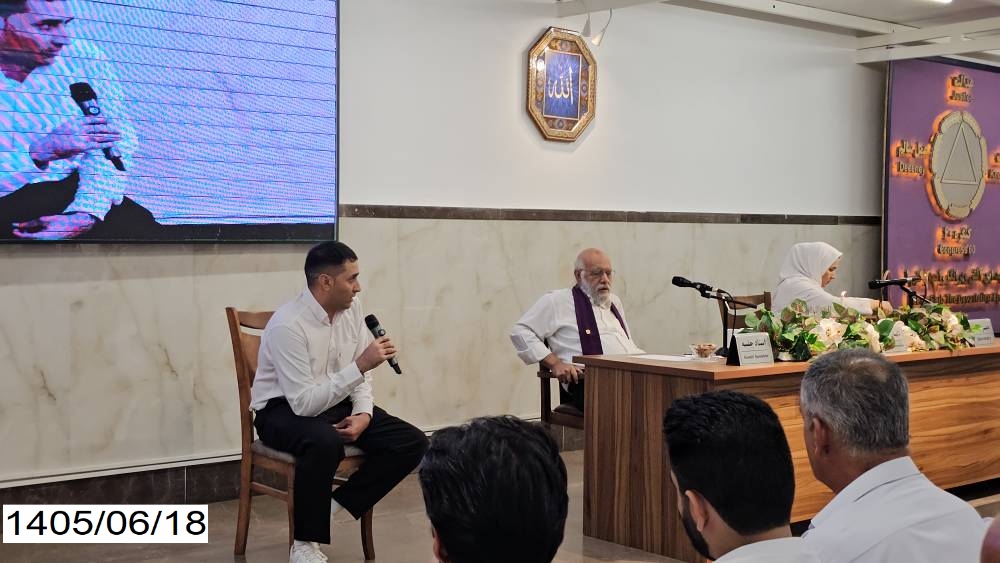
The thirteenth session of the 87th term of Congress 60’s educational workshops, held for Travelers and Companions, was conducted on Wednesday, September 9, 2026, with the agenda “The Seventh Valley and Its Impact on Me.” This session was administered by Dr. Hossein Dezhakam serving as both the guest speaker and guardian with Companion Shahin serving as secretary.
In the Name of Allah, the Most Compassionate, the Most Merciful.
We begin the session by drawing strength from the power of the Absolute Power of Allah.
Hello, friends. I am Hossein, a Traveler and the Guardian of the session. I would like to ask everyone to observe fourteen seconds of silence and seek refuge in God so that we may free ourselves from our most powerful enemy, which is our own ignorance and lack of knowledge. Thank you, friends.
I would like to ask our esteemed secretary to give a three-minute summary of the previous session and introduce today’s agenda. After the secretary provided the summary of the previous session, Mr. Dezhakam started his speech:
I hope you are all doing well. Thankfully, I am doing well too. Today is September 9, and we are approaching the end of summer and the beginning of autumn. Hopefully, we will have a rainy and fruitful autumn and winter. God willing, all the rivers will be filled with water without turning into floods. It is 10:06 a.m., and we are at the Simorgh Building in Tehran.
In general, if I were to give you a report on Congress 60, I would say that we are busy working. We had Didebans’(Watchers)Week, which lasted two weeks, and approximately 90 percent of the branches were visited. Perhaps about 10 percent of the branches remain to be visited, and the Didebans will go to those branches as well. For each branch they have visited, they will send me a complete report detailing the strengths and weaknesses of that branch.
There is one point I would like to mention to our dear Agents. Agents must review all of the branch’s forms and make sure that they are up to date. In some cases, when these forms are submitted, the section at the bottom of the page containing the Congress Guardian’s information or the responsible person’s signature has been erased or is missing. Therefore, the Agent is responsible for all the paperwork related to the First Journey, the Second Journey, cigarettes, Jones, and everything else. They must check all of it to make sure that nothing is missing and that the writing is neither too dark nor too faint. So, I ask the Agents to pay attention to this matter because they are responsible for overseeing the branch.
The next issue concerns our Publications. At present, the responsibility of the Publications department is very substantial. We have calculated that, across all of Congress 60’s Publications departments, we have nearly 18 billion tomans’ worth of items, including books, CDs, pens, ballpoint pens, and so on. Sometimes a branch may have approximately 80 million, 50 million, 150 million, 180 million, or 200 million tomans’ worth of goods in its Publications department. If the person responsible for Publications has a shortage or discrepancy in their accounts, the Agent himself or herself will be held accountable. The Agent is ultimately responsible for this.
Sometimes, when an Agent is replaced, the new Agent thinks that they have to change everyone in every position—as if, for example, the republican party has been in government and then the democrat party comes to power, so all the members of the previous party must step aside, or vice versa. No, it does not work that way here in Congress 60. Becoming an Agent does not mean that you should replace the people responsible for Publications, the website, and everything else.
For example, at one of our branches, we have a person responsible for Publications whose accounts are extremely accurate and who has been performing very well. Then, all of a sudden, the Agent says, “No, I want to replace this person,” and appoints someone who does not know how to do the job, and then there is a shortage [discrepancy in their accounts]. Therefore, I ask the Agents to pay attention to this matter. If they want to make a change, that is fine. However, they should not initially tell the person that they intend to replace them. First, they should coordinate with Mr. Amir Ghadiri, who is responsible for Publications. They should contact him and ask, “Has this person been performing well in their position? Are you satisfied with their performance?” Then they can replace that person. We supervise the appointment of the person responsible for Publications, while the Agent also has a say in the decision.
Sometimes the person responsible for Publications is doing an excellent job and performing very well. They regularly come to the central office to obtain books and booklets because the person responsible for Publications is responsible for providing the branch with the supplies it needs.
There was a case where the person responsible for Publications had been very capable and meticulous, but the Agent replaced them. The new person had not come to purchase or obtain [Congress 60’s] books [to take to their own branches] for three months. They had not even come to get pens and paper. Therefore, this is an important matter. Those who become Agents should not make hasty decisions. Before they decide to replace people, they should consult with us. If they want to make a change, there is nothing wrong with that. But they should not say, “I want to replace this person because I want to put my pupil in charge of this responsibility.” Selecting your student is not a problem, but the person must be capable of doing the job properly. So, that was one issue that we have addressed.
The next point is that our research activities are also continuing as before in various fields. Articles submitted to scientific journals from China and Iran, and some other countries as well, have to undergo verification because there have previously been cases in which submitted papers contained fraudulent or fabricated material. Therefore, papers now have to be verified. This takes time, costs money, and creates numerous difficulties. Fortunately, because our papers have been original and of very good quality, our situation is much better.
At present, we have five or six papers. One is about fentanyl, one is about amphetamine, and one is about opium. We have also completed the experiments on heroin.
One of the papers is also a comparison of the DST method with other methods. That paper has also been accepted. In the field of addiction, we now have four papers that have been accepted—that is, they have been approved for publication—and we are only waiting for them to be published. Hopefully, they will be published soon. Last month was August, and universities are closed during August, while scientific journals generally do not publish during this period either. God willing, now that we are entering September—it is the eighth or ninth of September today—they will gradually resume this work.
Another important issue was that we had a paper on multiple sclerosis based on animal models. At this point, however, we emphasize that this is strictly at the research stage. Please do not bring patients with MS here, because we are not doctors and cannot diagnose, treat, or cure multiple sclerosis. We conduct the research, and afterward, it should be evaluated by universities and physicians, who can then determine how it should be applied.
Our paper on multiple sclerosis was a good paper because it deals with the myelin membrane, or myelin sheath. The nerve cells are covered by a protective layer, and when this layer becomes damaged—much like the protective coating around an electrical wire when it wears away—it causes a number of problems. In the world today, this myelin sheath is considered irreparable. However, through the work we carried out, the experiments we conducted, and the papers we published, including papers that were published in the United States, we demonstrated that, yes, the damaged myelin sheath in MS can be repaired and regenerated.
The sheath surrounding neurons, or the myelin sheath, becomes damaged in multiple sclerosis and is considered irreparable. Scientists generally believe that it cannot be repaired. But we demonstrated, based on these papers and the supporting evidence, that it can in fact be repaired. Our study was conducted on 72 laboratory rats. The work we carry out is then taken to the laboratories of universities such as the University of Cambridge or the University of Bristol, which are among the world's reputable universities. There, our experimental samples are examined using specialized equipment. What does that mean?
It means that, for example, you do not simply write down the results yourself [i.e. we carry out the experiments; however, the results are examined in the top-ranking universities in the world]. When you provide blood samples, cerebrospinal fluid, or brain tissue, and they want to examine these samples and study the RNA or gene expression, specialized instruments are used to determine the results. In other words, we do not conduct the tests ourselves and then say, “Yes, this result is good,” or “No, this result is bad.” No. The systems and instruments determine the results. This means that there is no way to manipulate the findings. This study was published some time ago, and interestingly, Harvard University, which is one of the world's most prestigious universities, had republished our paper. Scientifically, this is highly significant: for Harvard University, which is considered the world's top university, to republish a paper concerning multiple sclerosis is very important.
Many other scientific websites around the world—in other words, other universities—also republished our papers and highlighted them. This is a very significant matter. We are gradually establishing and demonstrating our credibility within the scientific community. Some of these things have already been accomplished. Then, for multiple sclerosis, we submitted a short communication, a brief report, followed by a more extensive report. For example, in the case of multiple sclerosis, we have so many claims and so much data that perhaps as many as 50 papers could be produced from it. The same could be true for colitis, where perhaps 50 papers could be produced, and the same applies to addiction. But because we have limited time, our work is somewhat more difficult.
The conditions for submitting and publishing papers are also somewhat challenging and difficult, especially because we come from a country that is subject to strict scrutiny, and sometimes excessive scrutiny. For example, suppose we say, “We gave this information to Snapp (transportation app in Iran), and they took it to Khorasan Square.” They might say, “Well, what was the Snapp driver's number? What was the vehicle's license plate number? Who was the driver? What was the chassis number? What was the engine number?”
The journals are that meticulous in trying to determine whether the results are actually valid or not. Fortunately, however, we have established a good reputation there, and some publications have written that we have been exempted from certain requirements imposed on some organizations because our work has been conducted properly. This is another issue related to our reports. We are continuously and systematically pursuing our research activities.
We also have the Scientific Congress of Addiction Knowledge. Tomorrow morning, I will have a meeting with the leading figures of this congress to see what can be done.
Now, our agenda item is [the Seventh Valley]: “The secrets of discovering the truth lie in two things: finding the path and what we derive from it.”
We learned something in Congress 60, and that is the principle stated in our First Valley: “Structures begin with thinking; without thinking, whatever exists will gradually deteriorate.” When we look at each of the Valleys, the First Valley is an introduction to all the others: structures begin with thinking. Therefore, when we talk about “the secrets of discovering the truth in two things,” we must think.
Sometimes we do not think things through. What does it mean not to think things through?
I was once traveling north, to Chalus. I had rented a car with a driver from Tehran to Chalus. There was another passenger in the car, and he happened to be a truck driver. Along the way, we got talking and decided to go into partnership to buy a truck. The thing was, I had absolutely no experience in the trucking business, and in driving trucks and it was not my line of work at all. Yet I actually went ahead with it. I traveled all the way from Tehran to look for and purchase the truck. That is what I mean by acting without thinking.
We bought the truck and became business partners. Two or three years went by, and during those two or three years, the only thing we ever got out of it was a 17-kilogram tin of cooking oil! One day, we had to pay for engine repairs; another day, we had to pay for tires. Then there were the transportation and transit expenses. It turned into a huge financial loss, simply because we had not thought the matter through, on the first day, the other person said, “It’s a good idea,” and I said, “Well, then, it must be good.”
Another day, we came across someone who manufactured specialized equipment for garbage bins, and we said, “Okay, let’s become partners.” Once again, it resulted in a great deal of loss and damage. These are examples of acting without thinking.
For everything to resolve, we have to discover its combination (passcode) and its secret. It has both a password and a secret. What is the password? Suppose you have something inside a safe. The secret is inside the safe, but first you have to figure out the safe's passcode. What is the safe's passcode? What is the key? How can you open it? Can you open it with a key? Can you open it using electronic codes? Can you open it with a hammer? With a sledgehammer? Can you melt it down using carbide? There are a hundred different ways you might be able to open it. Which one will you choose? Which method will you use to open the safe? You have to think about it. Once you have thought it through, the safe can be opened.
When you open the safe, you will reach the secret. The secret is inside the safe. The treatment of addiction has a secret; it has a password. It has both a password and a secret. How can you discover it?
Today, everyone is thinking about stopping suddenly, having enough willpower, taking pills for a week, or simply taking it one day at a time, taking naloxone to block the receptors, taking some particular medication, or behaving in a certain way so that they can treat addiction within ten or twenty days. None of the current methods have succeeded in curing addiction, because none of them has found the combination or passcode.
They need to find the passcode so that they can enter the safe and retrieve the treatment for addiction from inside it. They have to find that particular passcode. Once you find the passcode, you can cure addiction.
The same applies to the issue of gaining or losing weight. You have to find the passcode. Once you find the passcode, you will achieve the desired result. At Congress 60, you see people losing weight as easily as drinking a glass of water or as easy as pie. On Monday, I helped a woman achieve liberation from obesity; she had lost 41 kilograms over a period of 12 months, quite easily.
How much do people put themselves through? They try all kinds of different things because none of them has been able to find the passcode, and therefore they have not achieved the desired result.
These are major challenges, and smoking is the same. The same applies to many other things. Even when we want to do the smallest thing, we have to think about it. We should not act on the first thing that comes to mind. We should pause, examine the situation, and think for hours: How should we do it? What action should we take? What should we do, and what should we not do?
Whatever we want to do may have many, many different possible approaches. Which one of these paths should we choose? We have to think about it. We have to look within ourselves and reflect on it until we find the right way. That is how we can solve our problems.
And when we want to identify a problem, we should sit back as an observer and look at it objectively. We should remain impartial like an observer and examine the issue from every possible angle. We need to investigate it from all sides until we arrive at the heart of the matter.
So, the secrets of discovering the truth lie in two things: first, finding the way—that is, finding the passcode to the safe—and second, what we derive from it; in other words, what we actually put into practice.
The passcode for curing addiction is the DST method. The question is: how much do you put it into practice? When we look at this, we realize that this is something we have to learn in everything we do—in all aspects of our lives. Whatever we want to do, we need to think about it.
Nothing will lead to a successful outcome unless you think about it. Quick, decisive, impulsive, and emotional decisions do not work for us. When you look at all the Valleys, from the First Valley to the Fourteenth, you see that the first step in all of them is thinking and the formation of structures. That is when you can achieve results.
Thirty years ago, we thought that if we wanted to become a strong NGO and stand on our own feet, we had to strengthen ourselves financially and also establish a strong physical base. We realized this, but what was the passcode? The passcode was to establish financial Legions. The passcode was to inform our people about what we wanted to do, clearly define the issue, and tell them: This is what we want; this is what we need; and this is the result we are aiming for.
That was the passcode. And the result was that whenever we ourselves came somewhere and established a branch, it did not really take off and did not achieve the desired result. But in every city where Congress 60 members themselves established the branch, it flourished and became successful.
Now, if you look at all the branches we have, our branches in the southern part of the country are doing very well. Their activities are very strong. The branches in the central part of the country are doing very, very well, and the branches in the east are also doing very, very well.
There are two areas where our branches are somewhat weaker, and we hope they will become stronger. One is the northern region. Our branches in the north are somewhat weak. In Isfahan, for example, you can see that there are 15 branches. In Mashhad, you see that they are constantly establishing new branches—strong branches with 300, 500, 600, or 700 people. In Kerman, we see that they are establishing strong branches, and the same is true in Yazd. But it is not like that in the north. I do not know whether it is because of the culture of the north or something else! We have to discover the passcode and the secret behind it.

The other area is the Azerbaijan region, where people speak Azerbaijani, such as Urmia, Ardabil, and Tabriz. Zanjan used to be in this category as well, but it is gradually getting better. Hidaj is also Azerbaijani-speaking, but it has become an exception: it has grown much, much stronger, and many branches have been established there.
These are branches that take a very long time to get off the ground. Now, this may be related to their culture. Perhaps there is a great deal of social courtesy and concern about what others might think. They may not want anyone to know that they have an addiction, and people may be afraid to come to Congress 60 to be liberated from addiction. They may be afraid that they will lose their reputation or that people will think badly of them. I do not know exactly what they are thinking.
We hope that, over time, the Azerbaijani-speaking branches will also become stronger. Hidaj is relatively strong, and Qeydar, which is also Azerbaijani-speaking, has improved. Zanjan has also improved. We hope that Tabriz, Urmia, and Ardabil will become very strong as well.
We have had a branch in Ardabil for quite a long time, but it has not yet become strong. Urmia has not become strong either. Tabriz, however, is gradually becoming stronger. We hope that all of these branches will also become strong and successful.
Sometimes we see a branch that is quite small, but it has a large number of Pahlavans [a Congress 60 member who donates 10000 dollars for the sake of Congress 60 progress; for the sake of research studies and to buy land or buildings] and many dedicated people who genuinely care. So, these are also some of our branches whose passcode and secret we need to discover. Hopefully, over time, they will become stronger as well.
I think it may have something to do with the mindset of the people there—that they should not be afraid of the issue of addiction. So, there has been addiction; there has been substance use. It is not as though anyone has committed murder.
Well, thank you all very much for listening to what I had to say.
Mr. Dezhakam’s Answer to Question on How to Use D-sap for Kidney Stones
One of Congress 60 male travelers asked Master Dezhakam: How should D-sap be used for kidney stones?
Master Dezhakam: D-sap can be effective for kidney stones, but its effect takes place over a long period. It needs to be taken for approximately five to six months.
In general, one of the best ways to use D-sap is for certain diseases because D-sap has anti-inflammatory properties. It can be of considerable help in inflammatory conditions, including breast cancer in women, as well as other conditions such as fatty liver disease, kidney and bladder problems, and intestinal infections. Since it has antiviral and antimicrobial properties, we used it for COVID-19 and the common cold. Because it is anti-inflammatory, it may also be useful for conditions such as multiple sclerosis, breast cancer, and various types of cancer. It also contains prebiotics and highly important lactobacilli, which can have an excellent effect on health.
We have even reached a point where we are moving toward using it for animals as well. What do I mean by that? I myself have a poultry farm, and instead of vaccines and such things, I use D-sap. Sometimes a disease suddenly breaks out in a poultry farm, and we see that all of a sudden 30,000 chickens, or half of them, have died. In such cases, we use D-sap both orally and in the form of inhalation.
The same applies to cattle farms. When cows and calves are dying or have gastrointestinal problems, giving them D-sap as part of their feed immediately improves their condition. So, it has a great many applications. There are research papers on all of these applications as well.
It is a very, very rich substance. It contains five or six acids that have antimicrobial and antiviral properties. It also contains minerals that are very beneficial for the body, including silver, copper, and iron, as well as a variety of other compounds.
As for the best way to take it orally, when someone wants to start, the amount should initially be between 5 and 10 cc per day. The caps of the bottles are usually 5 cc, so the person can take between 5 and 10 cc per day. This should be continued for 21 days—the first 21-day phase.
Then, after those 21 days, another 21-day phase should begin, this time with two doses a day, morning and evening, 12 hours apart.
After the next 21 days, the third phase begins, with three doses a day: morning, noon, and night, at intervals of eight or seven hours. In other words, there are three 21-day phases: first one dose, then two doses, and then three doses.
After that, it should be continued for up to one year. It is an edible substance and does not cause any harm. If you want to take D-sap regularly, there is no problem with that. At a minimum, it should be used five times a week. We are not saying that you have to take it every single day, but five or six times a week is very good for oral use.
For women's health conditions such as endometriosis—which some people know is a very serious condition and for which there is supposedly no treatment—or for certain fungal infections, some tumors, HPV, genital warts, and similar conditions, sitting in D-sap may help eliminate the fungi or these illnesses. Again, this is a long-term process. Endometriosis may take six months to improve because it supposedly removes those layers, much like stripping away fat.
For this purpose as well, the regimen is three 21-day phases: one glass of D-sap mixed with four glasses of water. During the first 21 days, it is used once a day; during the second 21 days, twice a day; and during the third 21 days, three times a day. After that, it should be continued five or six times a week for one year.
Congress 60 members have tested all of these applications. They had various problems, and their problems were resolved.
Then there is D-sap cream. We do not really have anything else for bedsores (pressure ulcers). We do not have a truly effective medication for pressure ulcers, which can be extremely severe. D-sap cream is highly effective for bedsores and promotes very good healing.
It is also very, very good for the face. It can remove blemishes and spots and reduce wrinkles. It has many different properties. In fact, even the most expensive women's creams cannot compare with D-sap.
Thank you very much. Thank you.
https://www.congress60.org/News/515323/%DA%A9%D8%A7%D8%B1%DA%AF%D8%A7%D9%87-%D8%A2%D9%85%D9%88%D8%B2%D8%B4%DB%8C-%D8%AC%D9%87%D8%A7%D9%86%E2%80%8C%D8%A8%DB%8C%D9%86%DB%8C-%D9%88%D8%A7%D8%AF%DB%8C-%D9%87%D9%81%D8%AA%D9%85-%D9%88-%D8%AA%D8%A3%D8%AB%DB%8C%D8%B1-%D8%A2%D9%86-%D8%B1%D9%88%DB%8C-%D9%85%D9%86
Translated by Elahe