In the name of the Almighty
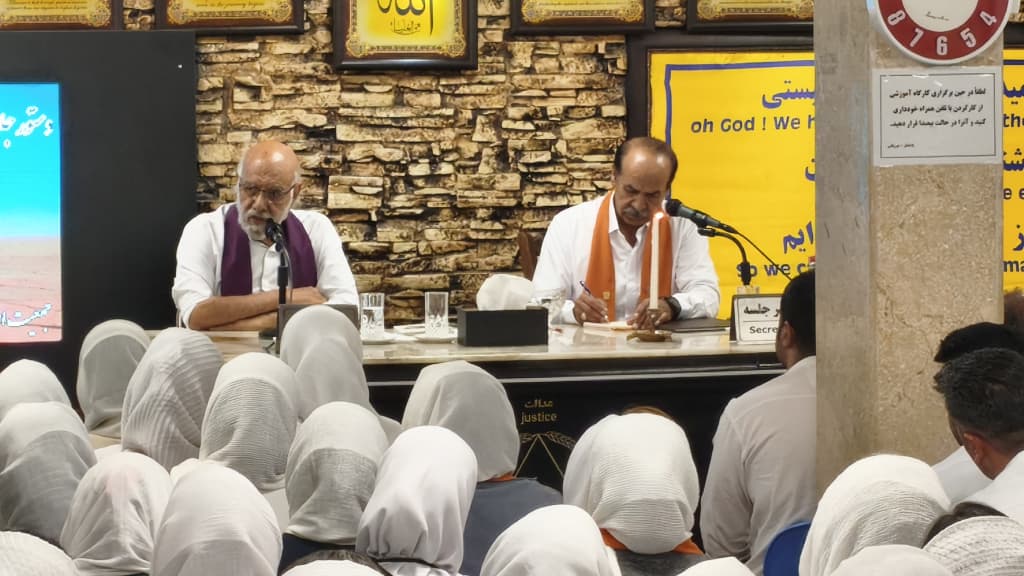
The fourth session of the 86th round of Congress 60 educational workshops, specifically for travelers and companions, started on Wednesday, October 29, 2025, at 10:00 AM. The session was hold under the guidance and supervision of Mr. Hossein Dezhakam, and Farhad, serving as secretary, with the agenda: “The Ninth Valley: When a force begins at a low level and gets to a higher degree, it reaches an endurance point.”
.jpeg)
Hello friends, I am Hossein, a traveler.
Please hand me the book Fourteen Valleys so I can take a look at the Ninth Valley. I hope all of you are doing well; by the grace of God, I am also well. Today is the 7th of Aban, and the time is 10:03 AM. We are in the Academy building in Tehran. The agenda for this week is the Ninth Valley, which states: : When a force begins at a low level and gets to a higher degree, it reaches an endurance point.
Before we begin the discussion on the Valley, I would like to mention a few preliminary notes:
During the Family (Companion) Assistants Council meeting held on Saturday, the 3rd of Aban, at 8:00 AM, with all assistants present, certain decisions were made. First, it was decided that when a Companion joins a Legion, if they are absent for more than one month without a valid reason, they must be referred to the Disciplinary Committee. Just like Travelers, they may be restricted from attending Congress 60 for up to six months. In other words, the same regulations that apply to Travelers will now gradually be applied to Companions as well. A Companion cannot repeatedly leave the Legion for long periods and then return without commitment. Of course, legitimate absences—such as illness or childbirth—are acceptable. However, if someone simply abandons their Legion without a valid reason, they will be referred to the Disciplinary Committee, fined, and temporarily prohibited from entering Congress 60.
The same rules apply to William White’s (Nicotine Treatment) and Jones’s (Healthy Nutrition) Legions. those who return to consumption or abandon their journey halfway must be referred to the Disciplinary Committee. For example, a person may enter the Jones’s Legion, but if they do not follow the program properly, they must be referred to the Committee. Likewise, it is not acceptable for someone to attend the William White’s Legion for one month, then stop for a while, and return whenever they like. Participation must be steady and committed, not based on personal convenience or mood.
Regarding the Jones’s Legion, the method we use is based on Healthy Nutrition. However, some people mistakenly refer to it as DST. The DST method is applied to the treatment of substance use, nicotine addiction, and many other conditions, but it is not designed for weight loss. Therefore, I named the method for weight loss after myself. When we refer to it, we call it the “Dezhakam Method.” This is a common practice for indicating which method is being used. I considered many names, but realized that no name would be more appropriate than my own. All groups—both Travelers and Companions—should use the term “Dezhakam Method” when referring to weight loss or weight gain programs. This ensures that, as the method gradually spreads, it remains clearly associated with Congress 60 and prevents misuse under other names. Keep this in mind.
In cities where we have Women Travelers’ branches, female substance users are not allowed from joining the Companions’ Group. For example, in Tehran, a female substance user cannot join the Companions; she must attend the Travelers’ Group. However, in a city like Zahedan, where there is no Women Travelers’ branch nearby, a female substance user may join the Companions’ Group. She must attend discreetly, without disclosing her substance use, to focus on learning the worldview and receiving training. Therefore, wherever a Women Travelers’ branch exists, female substance users must always join the Travelers’ Group, not the Companions’ Group.
We have asked the officials and Guides of Women Travelers in cities with branches, such as Tehran, Qazvin, and Mashhad, to participate in Companions’ Group sessions as guest speakers. Their role is to convey the message that if any Companion attending is a substance user, she can join Congress 60 and begin her cure journey. This applies only in cities where a Women Travelers’ Group exists. In the future, we may extend this program to nearby cities. Additionally, I have requested that Companions also be allowed to attend Women Travelers’ Group sessions if the conditions for increased interaction can be arranged.
In branches where the Guides—whether in DST, Jones’s, or any other legions—are a married couple and no other Guides are available, married or related Travelers and Companions are allowed to attend their Legion. For instance, in a city with only one Companion Guide, whose spouse is also a Guide, all Companions are obliged to attend that Legion—there is no other option. However, in branches where multiple Guides are available, pupils who are married or related should not be assigned to a married couple of Guides, as this can create many complications.
We are approaching the Golrizan (Money Donation Ceremony), and fortunately, last week I visited Qeshm Island to inspect the university building. Reports about it have also been published on the website. I held a meeting with the university instructors and spoke with them. The university offers engineering courses at both the bachelor’s and master’s levels. I emphasized strongly that under no circumstances should students be given extra marks—do not award grades if they haven’t studied. I asked the instructors to be completely strict and fair. I also mentioned that currently, we are actually operating at a loss at the Qeshm University branch. The tuition we receive from students is low compared to the expenses, including instructor salaries and other costs. Although it may amount to 70–80 million Tomans per month (which is not a very large amount), I made a point to them. I apologized for using the word “addict”, but I had to say it in front of them. Then I said: “It is through addicts (consumers) in the Congress 60 system that we have been able to build such a building, which has so far cost around 200–400 billion Tomans. We achieved this by working with and educating the consumers themselves. Now, as the instructors of these top students—having passed the entrance exam, the cream of the crop—what results or benefits are you providing in return through your teaching? What are you giving us in exchange?” This is a very important point. The Golrizan itself comes from awareness; it is born from the awakening of individuals. It’s no joke that such a magnificent building was constructed, or that another one in Tehran was built. How does it happen? Through awareness. No one gives a single penny (Rial) out of their own pocket for nothing. I’ve said this many times: “In a time when people would even steal the cane from the blind, how is it possible for a system like Congress 60 to help people?” Human beings are noble and good; if they see goodness, understand it, believe in it, and experience it, they can even sacrifice their own lives. That is why in Congress 60 we have the position of Pahlevan [a congress 60 member who donates 10000 dollars for the sake of Congress 60’s research studies and constructing new buildings and branches]. However, not everyone is granted the honor of becoming a Pahlevan. Some people become deeply moved when they see this tradition, but I cannot allow it in certain cases; they must first become strong and steadfast within themselves. Only when they reach that inner strength can they truly wear the mantle of a Pahlevan. This spirit of sacrifice and strength is what brings such achievements into existence—it is exactly the idea that “others planted, and we ate; now we must plant so that others may eat.” Others laid the foundations of Congress 60, worked hard day and night, and we are now benefiting from their labor. Therefore, we too must do everything within our power for others. And truly, we have members whom we see traveling day and night across different cities—both men and women—teaching, guiding, returning home at one or two in the morning, and then being back at work again at 8 a.m. They go from city to city, from one region to another, just to help others. Now, as we are getting close to Golrizan, the members have shown tremendous enthusiasm and are actively working so that they can establish very strong and powerful branches in their own cities.
Now, regarding today’s agenda, the Ninth Valley reads: “When a force begins at a low level and gets to a higher degree, it reaches an endurance point.”
It further states:
“This message is for those who have entered the new world and are aware of their true self. It is compulsory that you move from the state of words to the state of action and pay attention to earth and sky. With your profound intellect have strong faith in the blessing of the heavens and know that your reward will assist you further. Hence plant a precious seed or a valuable crop so as to gain enough food and also the comfort of a shade. Therefore, do as the command says.”
This is a remarkable point. What is expressed in the Ninth Valley is in fact one of the laws of nature. All of nature operates according to this principle: everything happens gradually. Even the seasons do not change all at once; you do not suddenly move from spring to summer, nor from summer to autumn. About forty-five days after the beginning of spring, we slowly move toward summer; and forty-five days after summer begins, we slowly transition toward autumn. Everything unfolds little by little. The leaves of trees gradually grow, then bloom, and eventually bear fruit. This process occurs quietly and steadily. When wheat is planted, there is first a period of underground activity before anything appears on the surface, and then growth continues slowly, step by step. During pregnancy, the embryo develops gradually, and after birth, the child grows gradually as well.
When we look carefully, we see that the entire nature is built upon the principle of the Tolerance Point. Tolerance develops step by step, little by little. Yet, we sometimes expect to accomplish things instantly. A person may have been using substances for thirty years and suddenly decides to quit overnight. By doing so, they disrupt the body’s physiology. Unfortunately, from the dawn of humanity until today, no well-planned and effective method for curing addiction to substances or alcohol has been discovered or implemented, because none of them took the law of the Ninth Valley into account. They all attempted sudden cessation. In many other situations as well, abrupt changes often cause severe damage. The message here is that things must be done slowly and gradually. Now, within this discussion, who is able to practice the Ninth Valley? Only those who have already fulfilled the Eighth Valley. If a person has not carried out the covenant of the Eighth Valley, then their journey ends there; they cannot enter the Ninth Valley. This Valley teaches us that whatever we intend to do, we must allow it time and opportunity to develop. You cannot expect a tree with no leaves or blossoms to suddenly produce pears; such a thing is impossible. You cannot plant a seed and demand that it instantly becomes wheat; this is impossible. If you have not studied throughout the year and only one week remains before an entrance exam, studying day and night will not produce the result you want. If you have not prepared during the school term and only three days remain before the exam, saying “I will stay awake day and night—I will drink coffee, take stimulants, drink coffee” will still not lead you anywhere. This is the principle the Ninth Valley teaches us.
If you try to run 100 meters right now, you will quickly be out of breath. But you have the capacity to run for ten hours—provided that you train gradually, step by step. Our DST method is designed precisely on this principle. It is based on the understanding that when a person is using substances or medications, the process of change must follow this natural so that the process of recovery can occur gradually. Unfortunately, the medical field has not recognized this principle. When psychoactive medications are prescribed, they are rarely withdrawn. And when tapering is attempted, it is often done over one or two weeks, or perhaps a month, in an effort to reach zero too quickly. The result is that these medications are almost never discontinued. A person who begins using psychoactive medications—whether sleeping pills, antidepressants, or similar substances— Often ends up taking them for life, because there is no effective method to gradually return the body to balance. If withdrawal is attempted, one medication is often replaced with another, because the principle of gradual adjustment is ignored. If this law were understood—how to administer a medication and how to gradually withdraw it—the issue could be resolved.
In one of our experiments, we needed to make rats alcoholic. The lab staff told us that when they try this, about half the animals die. I asked how they die. They said they give the rats 40% or 60% alcohol, and by the end of the twenty- to thirty-day experiment half of them are dead. I asked why they die, and they answered: “That’s a normal case— every scientist knows that in these kinds of studies roughly half of the rats will die.” I asked how they administer it. They said they start with a high dose on day one. I realized that their livers fail — it’s just like giving a person one or two grams of opium to swallow on the first day; many would die. Or if you tried to make someone an alcoholic by telling them to drink a whole bottle on day one, it’s obvious what would happen: even a single glass could knock them out, let alone a whole bottle. This is a very obvious mistake made even at university research centers when studying alcohol or heroin. We said that this protocol is useless — with that method half the rats die. How did the ethics committee approve it? The method is wrong. I said: If we want to make the rats alcoholic, we must use the DST method. Start from a low point — exactly as the Ninth Valley teaches — begin small and raise the dose little by little. They told us that if you want to do that, you can’t just change overnight: first study the method, test DST, get ethics approval, develop and validate the protocol, publish it, and only then apply it. Now, we are carrying out those studies. You see that even in scientific centers they don’t take the tolerance point into account. They suddenly give 40% or 60% alcohol from day one, and half the animals’ livers and kidneys fail and they die. That’s the natural result of ignoring tolerance point. If we take the tolerance point into account, we can do it properly.
This principle applies to everything we do. Our teaching is practical. We are not here to say, for example, that the Ninth Valley means “annihilation in God”. We want to understand what we are saying and know what we must do with it. Since we have implemented the DST method, we have observed that everything goes smoothly with DST. Using DST, we determined the amount of opium, opium extract, or any other substance according to each person’s tolerance point. One person’s tolerance point may be 5.5 cc per dose, 16.5 cc daily. Another person’s may be 3 cc per day. Someone else may have only 0.3 cc per day. The tolerance point is different for every individual, and we take that into account. But look at the common treatment protocols for addiction: they say to start everyone on 5 cc or 10 cc from the first day! there’s no calculation for the individual’s tolerance point, no attention to how much the individual has actually been using. On the contrary, in the Newcomers’ Legion in Congress 60, the guide asks directly: How much do you use? How much opium, heroin, or hashish do you smoke or eat? Based on the actual consumption, the guide determines the tolerance point and sets the correct dose. This principle applies to every part of life. Even in becoming financially stable, we must consider the tolerance point. This means that when we want to save money, we cannot do it all at once It takes four to ten years of steady saving to accumulate enough to buy a home or other assets. When we look at nature, we see that nothing changes all at once. There is no sudden revolution in nature. If such a sudden change occurs, it is destructive—like an earthquake, where the layers of the earth shift abruptly. Or a tsunami, where the sea suddenly breaks and waves of 30, 40, or 50 meters rise. These are revolutionary transformations.
Everything in the system must be gradual and step-by-step. We proceed slowly, moving from one point to the next. For instance, someone who used to consume 7 or 8 grams of opium per day is gradually reduced—little by little—down to 0.3 grams per day, and then eventually stops completely.
Today, many overdoses happen because people ignore the tolerance point. For example, someone who has been injecting one gram of heroin daily for years suddenly stops. After 20 days, or a month, their tolerance has dropped. If they then try to inject the same one gram again, their body cannot handle it—they risk stroke or death. They forget that their tolerance was previously high due to daily use, but after months of abstinence, it has fallen significantly.
In Congress 60, overdoses simply do not occur—even with opium syrup (OT). In all these years, I have not seen a single reported overdose caused by OT. Why? Because the dosage is carefully calculated according to each individual’s tolerance. For example, if the OT dose is one cc per day, taken in three divided doses (TDS), someone trying to go beyond the plan might take 1.2, 1.5, or 2 cc, but they will never take 5 cc at once. If the daily dose is 0.3 cc and they try to disobey, they might take 0.4 or 0.5 cc—but not several times more. They know their dose and respect it.
This is why overdoses do not happen in Congress 60. An overdose means exceeding the safe amount. “Dose” is the correct, safe amount, and “over” means above it. One of the biggest problems in addiction centers today is overdosing—death caused by ignoring the tolerance point. Many centers do not understand tolerance, and that lack of knowledge leads to multiple deaths.
.jpeg)
A person used to consume opium extract—five grams per day—but now they haven’t taken any for six months. If they try to take previous daily dose again, they don’t realize that their tolerance has changed. If they were to use it again, they should start with just a tiny, lentil-sized amount, but they don’t know this, and it could be fatal. This is what we mean by the tolerance point. We have a tolerance point in all aspects of our lives. When our worldview is weak and we lack tolerance, accidents happen. For example, in a car accident, the veins bulge due to stress or anger due to stress and anger—because the person lacks tolerance. Someone says a word to you, and you lose your temper because you lack your tolerance point. While parking, a fight might break out, and someone could even use a knife—why? Because they have no tolerance point. If I were in such a situation, I would say: “Do not argue with fools.” I would back up my car and park elsewhere. Even if the other person insists, I wouldn’t engage, because they are ignorant. But if you react, the result could be injury, legal trouble, or jail. Lack of tolerance point leads to these consequences. We must strengthen our tolerance point. Sometimes, we have to tolerate insults. (Laughs) Whatever someone says, respond calmly: “Yes, you are right.” While driving, people might call you names—stupid, idiot, or worse. Ignore it; think: “Do not argue with fools.” Move on. Whenever you encounter someone losing balance over a single word, you free yourself by stepping aside. Say it quietly to yourself—don’t speak aloud and provoke further conflict. This is what the tolerance point is. We must learn tolerance point in every area of life. Sometimes, we need to yield, step aside, and not react simply because we lack tolerance point. Through practicing our worldview and education, gradually we can raise our tolerance point—from running 100 meters to 10 kilometers, and in many other areas of life. These are the lessons about the tolerance point. I hope everyone applies the principle of tolerance in the Ninth Valley and discusses it during sessions. That’s all from me—thank you for listening.
Hello friends, I am Hossein, a traveler.
I’d like to share a message. The photo on the blue Liberation Forms—used for travelers receiving liberation— must not be stamped at all. Please make sure this rule is strictly followed. Also, regarding Rule Eleven (the practice of collecting voluntary contributions during sessions), I have received reports that in some places the collection process takes fifteen or thirty minutes, or it is done too quickly. Everywhere, it should be clearly stated that participants can pay before the session using the POS machine, take their receipt, and place it in the circulating basket. This ensures that the total contributions under Rule Eleven are not reduced and that session time is not wasted. All agents must be trained to ensure contributions remain sufficient and sessions run smoothly.
[Translator’s note: the point below was made by Mr. Dezhakam after one of the member’s experiences sharing (contribution)]
The Eighth Valley teaches us to make efforts to examine yourself and identify your weaknesses and strengths, what you want, and your intended actions. This is similar to the tolerance point: we do not expect that you will go one day and immediately become a sage or fully enlightened person You must work gradually toward these points and plan your life step by step.
Typed by: Companion Fatemeh, Salman-e-Farsi Branch
Translated by: Companion Samira, Legion 18, Sheikhbahaei branch of Congress 60, Isfahan, Iran
November 11, 2025
.jpg)
Revised by: Companion Marjan