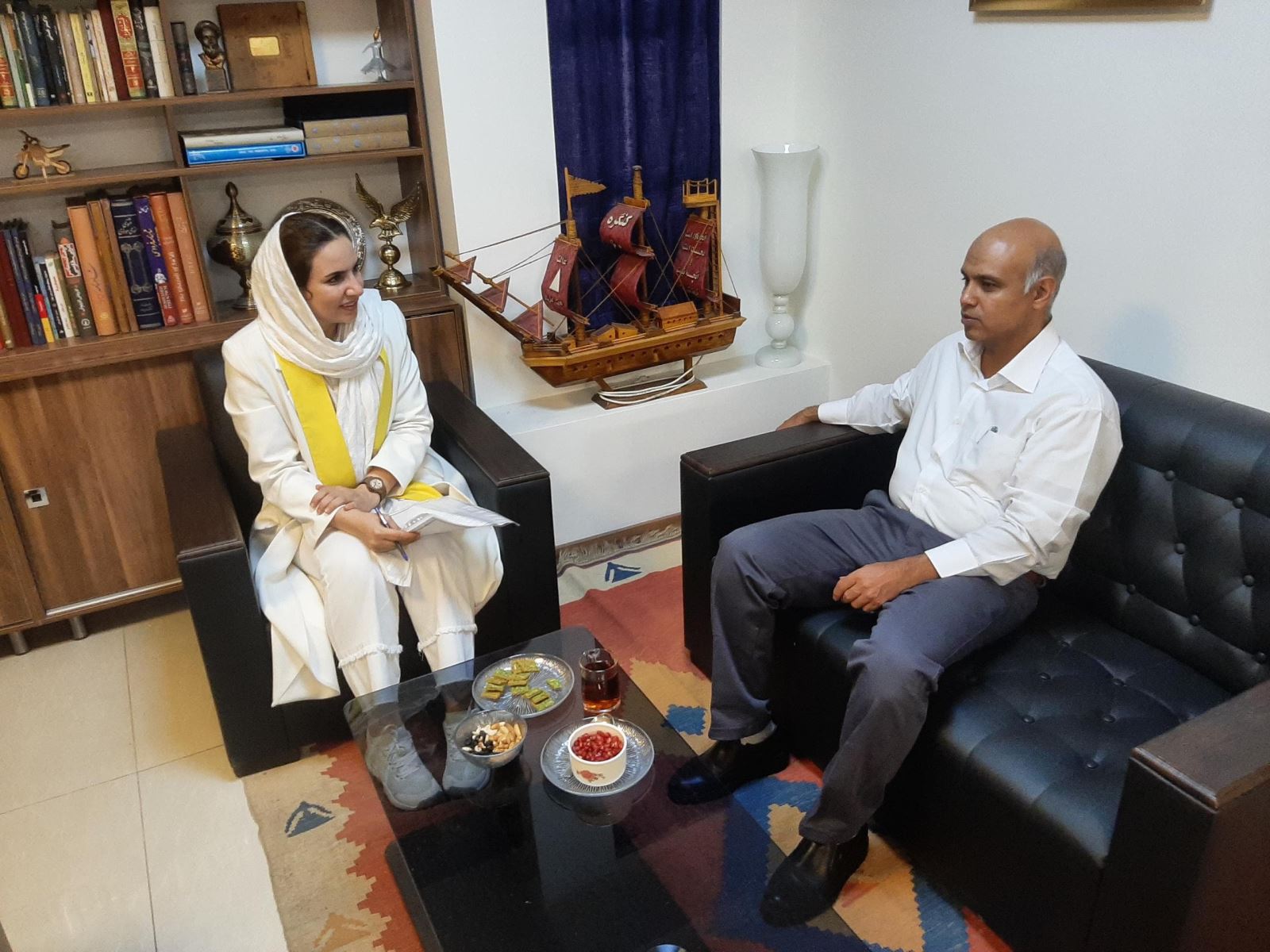
On the 16th day of Azar 1404 (December 7, 2025), during the third interview session, we were honored to meet with the Dideban (Watchman) of Congress 60 60, Dr. Amin Dezhakam, and to further benefit from his teachings and experiences.
His teachings through the worldview pamphlets and the CDs in the Dezhakam application have been pathfinders in most psychological issues of human beings.
Also, we, the members of Congress 60 60, regularly benefit from his teachings in different branches and his various interviews through the website of Congress 60 60. Again, we seized the opportunity to have another conversation about music with him. We hope that it will ingratiate itself with friends.
16. Who arranged and recorded the piece “Thanksgiving” and “Liberation”?
Dr. Amin: I wrote the piece “Liberation” in 1997, and its arrangement was done in 2005 by me and with the help of Hamidreza Farshad, a member of Congress 60 60 who is currently present at the archery ground, using the Organ [instrument] that he had at home.
Later, this piece was recorded in Congress 60 60, and on the day of the recording, at my suggestion, I whistled on this sound. Mr. Abbas Amir-Ma’afi, who is skilled in the field of sound systems, recorded the sound of the whistle with a microphone, and it was added to the piece, so now you can hear the sound of the whistle in the song.
At that time, it didn’t have any poetry. By the way, I remember that a known poet had come to Congress 60, and Mr. Dezhakam said to him, “Will you write a poem on this music?” He said that “I don’t feel like it, or I can’t, or I don’t write”; in any case, it wasn’t done.
The poem was written in 1994. This composition doesn’t have a singer and is performed as a chorus.
The piece of “Thanksgiving” was actually two voices; a woman and a man. We recorded a sound several times in the studio; this means that we took a record and remixed it several times. It’s like many people are singing together. This technique was used. Moreover, Mr. Zahraei also sang it himself.
17. On what basis do humans turn to music (musical instrument or song) and what characteristics in them make them choose the type of instrument?
Dr. Amin: We have both sections of [playing] instrument and [singing] songs in the Music Legion of Congress 60 [this legion is held every Friday in some branches of Congress 60], because a full orchestra includes a musicians section and a choir section. Sometimes the choral part, the part where people sing, includes both male and female singers that covering the four standard voice ranges; bass, tenor, alto, and soprano. Even the number of choirs may be a hundred people along with eighty musicians.
Therefore, a very important part is the choral part. Sometimes we listen to a piece of music and feel as if something is missing and incomplete; that piece lacks a soloist [a solo singer] or chorus. Considering this issue [a music band includes both sections of musicians and singers], we suggest that they choose one of these two—instrument or song—in the music legion, but the choice is completely optional.
Now, a question is raised here, based on which criteria shall I decide to be a singer or musician or even which instrument to play? Based on your inner feeling, you have to choose whether you will become a singer or a musician or what instrument to play.
If singing song more helps you to express yourself and feel good and express or balance your feelings and emotions in the form of singing, then it is better to choose it instead of playing an instrument.
A musical instrument may do this for another person; a stringed instrument for one, a wind instrument for another. It depends on the characteristics of Nafs (ego) and the inner characteristics of the person.
The meaning is that the selection criterion is the effectiveness of that instrument or song in the human spirits to help him more; because art is a medicine in its true meaning. I have already said that it is a cure and medicine.
18. What conditions are necessary and sufficient to learn music and which is the most important?
Dr. Amin: First, interest, which is the basis, means that the desire must exist in the individual; the second issue is the principles of instruction, which means the correct instruction method; and the third side is effort and perseverance in the matter of learning.
One side is your want, that is the base of the triangle. One side is the method that must be correct, meaning that it must be in the right discipline and must have principles; principles mean that it follows the law of cause and effect; for example, you progress to the next steps in order, the path of the obtained results is obtained from the previous path, and there is a logical relationship between the educational principles. The right instructional method is that which will lead you to the result. You see, for example, in music, we must achieve some capabilities and abilities; the method is more correct that can reach a person to the necessary abilities in art or music in the shortest possible time.
One method may help you reach those capabilities in ten years. Another method may do this in two years. This one that help you reach your want it in two years is more correct, but it is not a sufficient to have a good method, you should practice at least 3 to 4 hours for per hour of instruction to complete this triangle.
19. Is there a mechanism for conveying the sensation during the time of performance, playing instruments and singing songs? Or does it happen unconsciously based on the purification the person performs or the feeling the person has at the moment of performance?
Dr. Amin: You see, a good sense is like a Porsche or a rocket (a spacecraft) or an F-35 or F-18, and a bad sense is like a worn-out or inappropriate car (I won’t mention names so that the person who owns that car doesn’t get upset).
Certainly, comparing a poor-quality or weak car to a high-quality car is like comparing a weak sense to a strong sense. It’s like comparing an airplane to a helicopter or a car.
What does being strong of the sense depend on? It depends on those refinements and purification that a person does, how much his sense is purified and how much a person has evolved in that matter. You may be in a bad mood one day. It’s like an F-18 that doesn’t work that day or a Porsche that splutters that day. It may still move much better than a broken-down car, but surely the function will drastically drop.
Like a fighter plane that has a problem and has a speed of 1,000 km instead of having a speed of 1,800 km, or it cannot perform some movements, so look at the polluted sense in this way.
If you have a strong feeling, but one day your feeling is negative and polluted, it’s like a Porsche that splutters. But a person whose sense has not developed is like that poor quality car.
Now, in order that we can be able to perform the piece of music with a good feeling, we must be well-trained, obviously. Performing the pieces in front of a crowd is difficult and tough.
In order that we can be able to perform the piece well, the importance of purification remains in situ (I don’t want to make it too spiritual now), but certainly the feelings of a musician, a singer, the voice that comes out of a singer can be sharp and trenchant like the stones of the mountain or round and soft like the stones of the river. The rock on the bottom of the river won’t hurt anyone’s hand, but the mountain rock will hurt your skin if you are not careful.
Humans are the same. If a person’s sense is polluted and not purified, that person hurts and harms [others] as if they have poison. However, a stone that is in the river, the water passes through it regularly [here human beings are likened to stones with sharp corners]. That water is a symbol of the flow of love. It means that a person in whom love flows rolls and rolls, and they may be faced with flood and other things [in their path], therefore, their sharp corners will be taken [and it will be round].
A singer works hard for many years so his voice will be pleasant, which means they have to become a rock on the bottom of the river, where the water regularly passes over them. The flood comes, the person rolls and rolls, until their sharp angles are smoothened. Then when this person presents something or sings, their voice is pleasant. The same holds true for a musician.
So this is the general process, but sometimes you want to perform; you have emotions, but you may get stressed in front of a crowd and not be able to express your feelings.
It’s like when you want to contribute [in Congress 60 meetings], but you get stressed and afraid, and you can’t contribute well. You have to make contributions in meetings, so how? You must contribute so much that it becomes correct [and you can contribute well, express your experiences without fear and stress].
Here in the workshops that have been designed for Music Legion, you should regularly play musical instrument and or sing so that gradually learn how to express yourselves in public.
20. Why can’t you practice music when your feeling is in a mess? What is the solution?
Dr. Amin: The solution is to practice when you’re feeling is in a mess.
But when you are sick, it is different. I tell the persons who play the wind instrument, never play instrument when you have a cold, because playing the instrument and the pressure on the sore throat will make the disease heal later.
Or maybe your situation is in a mess; even in that situation, if you play an instrument, you will be out of balance. But many times when you have not reached the point of crisis and uproar and you’re upset and your mood is not very good, practicing music can even bring you back to life.
21. How to achieve internal changes through music?
Dr. Amin: When you learn to read a line of music and can perform a piece of music, it creates a capacity in human and is a structural change. Like someone who is illiterate and develops their literacy in reading and writing, how much will their life change? Or if someone learns a language they don’t know, how much will their life change? Music is also an international language, when you learn to read a note and can play it, it is very impressive. So, one change happens due to musical knowledge and musical skill (both singing and instrument) and another change due to the performing special pieces.
Each piece of music expresses a narrative and a story, such as Swan Lake ballet, Symphony No. 9 (Beethoven), Tchaikovsky’s Nutcracker, or many other pieces of music, including works by Schubert, Chopin, Verdi operas, sonatas by Mozart, Beethoven, Bach, and even pop music. Each of these, or the music of some movies, expresses a narrative, a story, and a truth.
When you start practicing and playing, for example, you can play a love story in such a way that you and others will cry, or you can play a piece in such a way that others will be happy and get energy and vitality.
Well, when you manage to work on a piece for days, weeks and months and present that piece in its beautiful and original form, this is another part of the change, too.
So we have two changes in music; first in learning musical skills such as reading the line and playing and performing techniques, second in how to perform musical works. When you play a piece and everyone is ecstatic, see how much it affects you. The effect you have on others will also return to you.
22. According to your statement, different languages express different concepts, does the music of different cultures and countries also have this feature?
Dr. Amin: To answer this question, I don’t want to go into the concept of multiple lives and I want to look at it from another angle. Every culture has a method of life, a civilization, a tradition, a food, a sociable principle, celebrations, and occasions. Therefore, the senses [feelings] they have in that culture are different from other.
If they are similar, they become one, thus each of these is different and has a special color because of the way they live and the variety of feelings they have, even their clothes and their ceremonies. These cultures have some arts; They also have handicrafts and music that they call folk music.
For example, the folk music of Lorestan or Kurdistan, which for thousands or hundreds of years expressed the current feelings and emotions between the people of those lands, they have music for their happiness, music for their mourning, music for their war—different themes that are performed with special instruments (such as reeds, some stringed instruments) in order to express those feelings.
The result is that each of these types of music has a color spectrum and its own world. Now these themes (folk music) may have an attractive or healing aspect for a person, and they will experience a joyful moment by performing those pieces, but it is not necessary for us to experience all the feelings. Everyone experiences a range of these emotions based on their needs. It is not the case that a person tries to experience all these feelings, because it is beyond the capacity of a person.
Of course, some people may have a high capacity and can experience a greater variety of senses, but usually each human being’s need is satisfied by one range of these feelings.
23. For a long time, the taboo for female travelers to be present in the public meetings of the Congress 60 has been broken; will this group be attracted to music, too?
Dr. Amin: incidentally, we had a conversation about it. Mr. Dezhakam decides whether to hold a separate training class for female travelers or to allow them to enter the music legion; it is up to him.
24. Dr. Amin, which piece of music do you like the most?
Dr. Amin: It’s a difficult question, because in every sense, one of the pieces is good, but I played the Dezhakam’s March, which is composed by him, and the piece “Autumn” which I mostly played for myself. So I love all of them, based on the situation, each one conveys some [special] senses to me and I am very impressed with the piece “Winter”.
After the interview with Dr. Amin, my being was filled with new knowledge and science that I must try to convey to my heart, but I know that in this path, what is needed is to try to stay on the straight path and continue.
Interviewer: Companion Mozhgan
Photographer: Companion AliAkbar
https://congress60.org/News/477702/-%D9%87%D9%86%D8%B1-%D8%AF%D8%B1-%D9%85%D8%B9%D9%86%DB%8C-%D8%AE%D9%88%D8%AF%D8%B4-%DB%8C%DA%A9-%D8%AF%D8%B1%D9%85%D8%A7%D9%86-%D9%88-%DB%8C%DA%A9-%D8%AF%D8%A7%D8%B1%D9%88-%D8%A7%D8%B3%D8%AA
Translated by companion Shadi
Revised and edited by Elahe